How to Choose the Right Food Delivery Bags for Your Restaurant
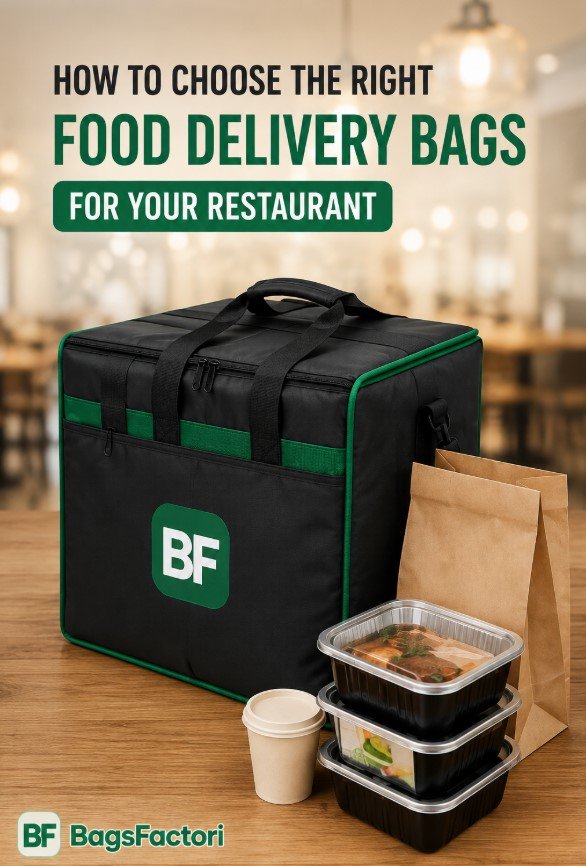
The right Food Delivery Bags for Restaurants can improve delivery organization, protect packaged meals and create a more professional presentation for customers. However, restaurant owners frequently make the mistake of buying bags based primarily on price or exterior appearance.
A better approach begins with your menu, packaging dimensions, delivery distance, rider vehicle, order volume and cleaning requirements.
Start With Your Food Packaging
Measure the actual containers your team uses. Pizza boxes, burger boxes, meal trays, beverages and catering containers require different bag shapes.
A delivery bag that is unnecessarily large allows packages to move during transit. A bag that is too small may compress packaging or prevent staff from loading multiple orders efficiently.
Measure width, depth and height, then consider how many orders a rider normally carries per trip.
Choose the Correct Insulation
Insulated Food Delivery Bags typically combine an outer fabric, foam insulation and reflective or wipe-clean inner layer.
Insulation helps slow heat exchange, but thicker insulation does not automatically solve every delivery problem. Closure design, loading temperature, empty space, weather and how often riders open the bag also influence performance.
For longer delivery routes, discuss insulation thickness and closure construction with the manufacturer rather than simply asking for a “thermal bag.”
Food Delivery Bag Material and Quality Comparison
| Material | Durability | Water Resistance | Typical Use |
| 600D Oxford | Good | Good with suitable coating | Standard restaurant delivery |
| 1680D Oxford | Very Good | Good | Heavy daily fleet use |
| PVC Tarpaulin | Very Good | Very Good | Rain/spill-prone operations |
| PE/EPE Foam | N/A | N/A | Thermal insulation |
| Foil/Reflective Layer | N/A | Wipeable depending on construction | Thermal interior |
| PP Board | Structural | N/A | Shape reinforcement |
2026 Food Delivery Bag Price Comparison
| Bag Category | Indicative 2026 Market Price | Best For |
| Basic Insulated Tote | Rs.200–Rs.600 | Light commercial use |
| Standard Food Delivery Bag | Rs.500–Rs.1200 | Restaurants and takeaway |
| Structured Delivery Bag | Rs.800–Rs.1800 | Repeated commercial delivery |
| Rider Backpack | Rs.100–Rs.300+ | Motorcycle/bicycle fleets |
| Custom OEM Branded Bag | Rs.700–Rs.2500+ | Chains, franchises and platforms |
Actual pricing depends on order volume, size, material, insulation, frame, compartments, branding and freight.
For example, very large wholesale quantities can substantially reduce factory unit prices, while smaller custom orders typically cost more per piece.
Consider the Rider’s Transport Method
A hand-carried bag may work for short restaurant-to-customer deliveries, while motorcycle and bicycle riders generally require more secure carrying systems.
A Food Delivery Backpack should distribute weight appropriately and may benefit from padded shoulder straps, chest support, reflective details and reinforced attachment points.
Vehicle-mounted bags require different structural considerations from backpacks.
Think About Cleaning Before You Buy
Food delivery environments involve sauces, condensation, grease and spills. A complicated interior with inaccessible corners can become difficult to maintain.
Choose a wipe-clean liner and discuss seam construction with the manufacturer. Restaurants should also establish regular cleaning and drying procedures so bags do not remain damp between shifts.
Choose a Bag for Your Menu
Restaurants should avoid treating every menu category identically.
Pizza businesses generally need wide horizontal carriers. Burger and fast-food businesses may need structured cube or rectangular bags. Catering operations often require larger carriers. Frozen and chilled food businesses may require more specialized thermal configurations.
This is why choosing by application produces better results than buying a generic bag solely because it is advertised as “insulated.”
Use Custom Branding Strategically
Custom Logo Food Delivery Bags provide a visible branding opportunity on streets, at customer doors and around restaurant locations.
Logo size, placement and printing method should be decided during product development. High-volume restaurant chains should also document approved brand colors to improve consistency across repeat orders.
Evaluate Cost Per Use, Not Only Purchase Price
The cheapest delivery bag is not always the lowest-cost option.
Imagine one low-cost bag requires replacement several times while a better-constructed bag remains serviceable for a longer period. Even though the initial purchase price is higher, the total equipment cost per delivery may be lower.
B2B procurement should therefore evaluate stitching, fabric, zippers, webbing, insulation, structure and expected usage alongside unit price.
Related Food Delivery Bags for Restaurants
- Custom Burger Delivery Bags for Fast Food Restaurants
- Insulated Pizza Delivery Bags for Pizzerias and Restaurant Chains
- Commercial Catering Delivery Bags for Hotels and Caterers
- Frozen Food Delivery Bags for Temperature-Sensitive Orders
- Delivery Bag Materials Guide for Restaurant Procurement Teams
Ask for a Sample Before a Large Order
For a custom bulk order, test a sample with your real packaging.
Load the bag exactly as staff would during service. Check whether containers fit correctly, whether the zipper or flap closes easily, whether riders can carry it comfortably and whether the interior can be cleaned efficiently.
Real-world sample testing can identify design problems that are difficult to notice in drawings.
Frequently Asked Questions
What is the best material for a food delivery bag?
600D Oxford is widely used for standard commercial bags. Heavy-duty applications may benefit from 1680D Oxford or PVC tarpaulin, depending on the operating environment.
How thick should food delivery bag insulation be?
There is no universal thickness for every restaurant. The correct insulation depends on delivery duration, food type, climate and bag design.
What size delivery bag should my restaurant buy?
Measure your largest common packaging and determine how many orders riders normally carry. The internal bag dimensions should then be developed around that loading pattern.
Are custom food delivery bags worth buying?
For restaurant chains and professional fleets, customization can improve packaging fit, rider workflow and brand presentation.
How much do food delivery bags cost in 2026?
Simple wholesale thermal bags may cost only a few dollars at large factory quantities, while reinforced, structured or customized commercial bags can cost $10–$30+ depending on specifications and purchasing volume.
Can food delivery bags be waterproof?
Water-resistant or highly water-resistant constructions can be produced using appropriate outer materials such as coated Oxford or PVC tarpaulin. Seams, zippers and openings also influence overall protection.
Should I use a backpack or hand-carry bag?
Motorcycle and bicycle fleets often benefit from backpacks or vehicle-mounted designs, while hand-carry bags may be practical for short-distance or catering applications.
Can BagsFactori manufacture bags to our restaurant’s dimensions?
Yes. BagsFactori’s OEM/ODM model supports custom size, structure, material, color, compartments and logo branding for B2B orders.