Manufacturing Process
Professional OEM/ODM delivery bag manufacturing with custom branding, practical materials and B2B support.
Built for business buyers
This page is imported as editable Elementor custom widgets with content and style controls.
Custom manufacturing
Made to your size, logo, material and structure.
B2B bulk support
Built for businesses, fleets, distributors and repeat orders.
Export-ready packing
Carton packing and dispatch support for local and global buyers.
Fast quote support
Send details on WhatsApp for MOQ, pricing and timeline.
Delivery Bag Manufacturing Process: From Buyer Specification to Bulk Production
Professional Delivery Bag Manufacturing begins long before fabric reaches the cutting table. A successful custom order requires the buyer’s operational requirements to be translated into dimensions, materials, construction details, branding and quality standards that a factory can reproduce consistently.
BagsFactori supports OEM and ODM production for food delivery, restaurant, courier, logistics, medical, pharmacy, chilled, frozen and other commercial bag applications.
Understanding the manufacturing process helps B2B buyers prepare stronger RFQs, approve samples more effectively and reduce specification problems during bulk production.
Stage 1: Understanding the Buyer’s Requirements
The first stage is defining what the bag needs to do.
The manufacturer needs information such as dimensions, expected contents, maximum load, quantity, operating environment, insulation requirements, carrying method and branding.
A request saying only “I need a high-quality delivery bag” leaves too much room for interpretation.
A detailed specification creates a much stronger foundation for quotation and manufacturing.
Stage 2: Material Selection
Different applications require different materials.
Food delivery bags may use Oxford fabric, PE foam and reflective lining. Logistics bags may use PP woven polypropylene or PVC tarpaulin. Medical applications may require specialized liners and temperature-management systems.
The material combination should be selected according to performance requirements and target price.
Material and Quality Selection Table
| Component | Common Material | Role in Manufacturing |
| Outer Shell | 600D Oxford | Standard commercial exterior |
| Heavy-Duty Shell | 1680D Oxford | Greater abrasion resistance |
| Weather-Resistant Shell | PVC tarpaulin | Rain/spill resistance |
| Sorting Bag Body | PP woven polypropylene | Lightweight logistics construction |
| Insulation | PE/EPE closed-cell foam | Thermal resistance |
| Thermal Layer | Aluminum reflective lining | Supports insulated construction |
| Structure | PP board | Shape and base reinforcement |
| Handles | Polyester/nylon webbing | Carrying support |
| Closure | Heavy-duty zipper | Repeated commercial access |
| Branding | Print/embroidery/labels | Customer identity |
Stage 3: Pattern and Product Development
Once dimensions and materials are established, the bag design is translated into individual pattern components.
Allowances must be considered for seams, foam thickness, zippers, folding and internal structures.
This is particularly important for customized bags because external dimensions and usable internal dimensions are not always identical.
Accurate pattern development contributes directly to repeatability during bulk manufacturing.
Stage 4: Prototype or Sample Production
A sample allows the buyer and factory to evaluate the design physically.
The sample should be checked for dimensions, materials, zipper operation, handle position, internal structure, logo size and overall workmanship.
The buyer should test the sample using the actual products it will carry.
This stage is the best time to request adjustments because changes become more difficult after bulk material cutting begins.
Indicative 2026 Sampling and Production Cost Factors in Pakistan
A manufacturing-process page should not publish a fake universal “market price per bag,” because every OEM project has different specifications. A more useful B2B benchmark is:
| Development / Production Factor | Indicative 2026 Cost Impact |
| Simple Unbranded Prototype | Approximately Rs. 2,000–5,000+ |
| Custom Branded/Structured Sample | Approximately Rs. 4,000–10,000+ |
| Complex Specialist Prototype | Approximately Rs. 7,500–20,000+ |
| Printing Screens / Setup | May involve separate setup charges |
| Custom Packaging | Additional according to specification |
| Bulk Unit Price | Falls or changes according to quantity and specification |
| International Sample Courier | Additional according to destination and chargeable weight |
These are indicative planning ranges only. Buyers should request a project-specific quotation.
Stage 5: Buyer Sample Approval
Sample approval should be documented clearly.
If changes are required, dimensions or construction details should be updated before approval.
For large orders, the approved sample can act as a physical quality reference.
Buyers should avoid approving a sample and then making informal specification changes without updating documentation because this can create confusion during production.
Stage 6: Bulk Material Preparation
After approval, bulk materials are prepared according to the confirmed specification.
Color and material consistency should be checked, particularly where brand colors are important.
The factory also prepares insulation, lining, webbing, zippers, structural panels and branding components.
For repeat orders, maintaining documented material references improves consistency.
Stage 7: Fabric Cutting
Fabric and internal components are cut according to approved patterns.
Accurate cutting helps maintain dimensions across the production batch.
Where multiple layers are used, outer fabric, insulation, lining and reinforcement may require separate cutting processes.
Material utilization is also important because inefficient cutting can increase waste and production cost.
Stage 8: Printing and Branding
Depending on the design, branding may be applied before or during assembly.
Screen printing is useful for many straightforward logos. Heat transfer can accommodate more detailed graphics. Embroidery provides another branding option for suitable fabrics.
The correct method depends on artwork, material, quantity and required appearance.
Brand position and dimensions should be approved on the sample.
Stage 9: Sewing and Assembly
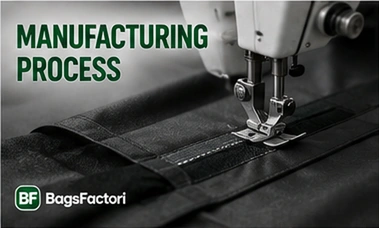
The individual components are assembled through industrial sewing processes.
This stage includes installing zippers, handles, webbing, pockets, insulation, lining and structural panels.
High-stress areas such as handles and strap attachment points require appropriate reinforcement.
The sewing method should reflect expected load and intended service conditions.
Stage 10: In-Process Quality Control
Quality control should not begin only after every bag is finished.
In-process checks can identify dimensional, stitching or branding problems earlier.
This reduces the risk of repeating the same defect across an entire production run.
Critical specifications should be identified before production so inspectors know which areas require particular attention.
Stage 11: Final Inspection
Finished bags can be checked for dimensions, workmanship, cleanliness, zipper operation, printing and overall appearance.
For relevant products, sample units may also be load tested or functionally checked.
Aesthetic tolerances and measurement tolerances should ideally be agreed before manufacturing.
Stage 12: Packing and Export Preparation
After inspection, finished products are packed according to the buyer’s requirements.
Export orders may use individual protective packaging, master cartons, carton markings and private-label packaging.
Carton dimensions should be optimized where possible because shipment volume can significantly influence international freight costs.
Related Manufacturing and Procurement Guides
- OEM vs ODM Delivery Bags Guide for B2B Product Development
- Delivery Bag Materials, Insulation, Lining and Hardware Selection Guide
- Commercial Delivery Bag Materials and Quality Standards Guide
- Delivery Bag Export and International Shipping Guide for Bulk Buyers
- Browse Custom Delivery Bags Available for OEM and ODM Manufacturing
How B2B Buyers Can Improve Manufacturing Quality
The best way to improve quality is to remove ambiguity.
Instead of asking for “strong fabric,” specify the intended fabric. Instead of requesting “thick insulation,” define or approve the actual construction.
Document dimensions, colors, branding, hardware and packaging.
Then use the approved sample as the reference for bulk production.
This makes quality expectations much easier for both buyer and manufacturer to understand.
Frequently Asked Questions About Delivery Bag Manufacturing
How are insulated delivery bags manufactured?
They are generally assembled from an exterior fabric, thermal insulation, internal lining, zippers, webbing and optional structural panels according to a developed pattern.
What is OEM delivery bag manufacturing?
OEM Delivery Bag Manufacturing involves producing a bag according to the buyer’s specified design or technical requirements.
Why is sample approval important?
A sample lets the buyer verify dimensions, materials, workmanship, branding and functionality before bulk production.
How much does a custom delivery bag sample cost in Pakistan?
Depending on complexity, an indicative 2026 custom sample development range may be around Rs. 2,000–20,000+, excluding some courier, tooling or specialist development costs.
Does bulk quantity affect delivery bag price?
Yes. Production setup, material purchasing and manufacturing efficiency can change the per-unit cost at different quantities.
When is logo printing completed?
The production sequence depends on the branding method. Some printing is completed before final assembly, while other branding can be applied at different stages.
How is delivery bag quality checked?
Quality control can include material checks, dimensions, stitching, zippers, handles, branding, cleanliness and functional/load checks where appropriate.
What should buyers send before requesting a quotation?
Provide bag dimensions, quantity, intended application, expected load, materials, insulation, branding, destination and reference images or drawings wherever possible.
Need pricing for Manufacturing Process?
Share your quantity, logo and size requirements for a quick factory quotation.