Materials & Quality
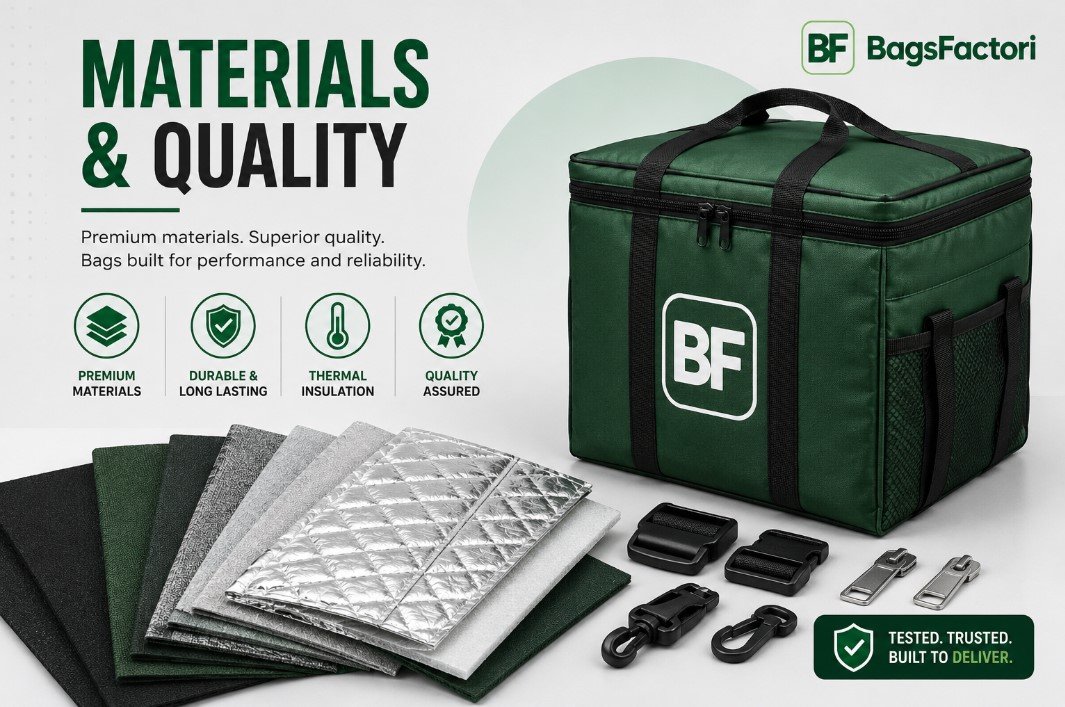
BagsFactori manufactures custom food, courier, logistics, pharmaceutical and Cold Chain Bags using materials selected according to buyer requirements. Understanding Delivery Bag Materials and Quality helps procurement teams compare quotations accurately and avoid choosing a product based only on exterior appearance or unit price.
Built for business buyers
This page is imported as editable Elementor custom widgets with content and style controls.
Custom manufacturing
Made to your size, logo, material and structure.
B2B bulk support
Built for businesses, fleets, distributors and repeat orders.
Export-ready packing
Carton packing and dispatch support for local and global buyers.
Fast quote support
Send details on WhatsApp for MOQ, pricing and timeline.
Delivery Bag Materials and Quality Guide for B2B Buyers
A delivery bag’s appearance is easy to evaluate, but its commercial quality depends on the materials and construction hidden beneath the surface. Fabric weight, insulation, lining, zippers, webbing, structural panels, stitching and reinforcement all influence how a product performs during repeated use.
Why Material Specifications Matter
Two bags with identical dimensions can have very different manufacturing costs and service lives.
One may use basic lightweight fabric, thin insulation and standard zippers. Another may use heavier Oxford, reinforced webbing, thicker foam and structural panels.
If suppliers are not quoting the same materials, comparing price alone is misleading.
A professional RFQ should therefore include detailed construction requirements wherever possible.
Delivery Bag Material and Quality Comparison
| Material / Component | Typical Application | Main Quality Consideration |
| 600D Oxford | Food, courier and general delivery | Good balance of cost and durability |
| 1680D Oxford | Heavy-duty commercial bags | Greater abrasion resistance |
| PVC Tarpaulin | Rider, cold-chain and outdoor bags | Strong water resistance and wipeability |
| Ripstop Nylon | Lightweight delivery applications | Tear-resistant woven structure |
| PP Woven Polypropylene | Logistics sorting and cargo | Low weight and economical strength |
| PE/EPE Foam | Thermal bags | Insulation thickness and density |
| Aluminum Thermal Lining | Hot/cold delivery | Reflective thermal barrier |
| Wipe-Clean Liner | Food and medical applications | Cleanability and seam construction |
| PP Board | Structured bags | Shape retention |
| Heavy Webbing | Handles and straps | Load distribution |
600D Oxford Fabric
600D Oxford Fabric is widely used for commercial delivery bags because it provides a practical balance between weight, durability, flexibility and cost.
It can be suitable for restaurant bags, courier bags and general rider applications.
The term “600D” alone does not define every quality characteristic, however.
Coating, thread construction, finishing and supplier consistency also influence actual performance.
1680D Oxford for Heavy-Duty Bags
1680D Oxford is a heavier construction commonly considered for applications involving frequent abrasion and repeated fleet use.
It can increase bag weight and cost compared with lighter alternatives.
For this reason, it should be specified where the operating environment justifies the additional material rather than automatically being treated as superior for every use.
PVC Tarpaulin Delivery Bags
PVC Tarpaulin Delivery Bags can provide strong resistance to rain, dirt and routine wiping.
This makes tarpaulin attractive for motorcycle fleets, cold-delivery operations and high-use commercial environments.
The quality of tarpaulin varies according to fabric reinforcement, coating and thickness.
Zipper and seam construction remain important because a water-resistant exterior alone does not make the entire bag fully waterproof.
PP Woven Polypropylene
PP woven material is commonly used for logistics sorting bags because it combines relatively low material weight with useful strength.
It can be laminated for improved surface protection and printing.
This material is generally more appropriate for warehouse and parcel consolidation than for premium structured rider bags.
Thermal Insulation Materials
Insulated delivery bags commonly use PE or EPE closed-cell foam between the outer fabric and inner liner.
The foam reduces the rate of heat transfer.
Performance depends on thickness, density, bag dimensions, closures and the complete thermal system.
Procurement teams should therefore avoid comparing products only by foam thickness without considering the rest of the bag.
Aluminum Thermal Lining
A reflective aluminum or foil-style layer is frequently used in insulated bags.
It contributes to the thermal construction and provides a surface suitable for many food-delivery applications.
The lining should be fitted correctly so it does not easily separate or become damaged during repeated cleaning.
Interior Liners
Food-service and medical delivery applications benefit from smooth, wipe-clean interiors.
A liner should be accessible for cleaning and appropriately attached around corners and seams.
Where buyers need specific food-contact or regulatory certifications, these requirements should be explicitly included in the procurement specification rather than assumed from generic material descriptions.
Zippers, Buckles and Hardware
Zippers are among the most frequently operated components of a delivery bag.
A strong exterior fabric offers limited value if the zipper fails early.
Procurement teams should inspect slider operation, zipper size, stitching around zipper ends and stress points.
Buckles, hooks and adjustment hardware should also be selected according to expected load.
Handles and Webbing
Handles transfer the load from the bag to the user.
Reinforced webbing can distribute force across a larger area of the bag body.
For heavy products, webbing may need to extend beneath or around the carrier rather than being attached only at short points.
The correct construction depends on maximum operating weight.
Structural Panels and Dividers
PP-board panels can help bags retain a predictable shape.
This is useful for pizza, courier, catering and rider bags.
Internal dividers can separate products or create compartments.
Aluminum-frame support may be considered for specialized structures where greater rigidity is needed.
Reflective Details
Reflective strips may improve the visibility of delivery riders in low-light conditions.
They can also become part of the visual design of branded fleet bags.
Reflective features should be treated as supplemental visibility aids and not substitutes for legally required road-safety equipment.
2026 Material Cost Impact on Bulk Delivery Bags
A technical page is better served by showing cost impact rather than pretending each material has one universal selling price.
| Material / Upgrade | Typical 2026 Cost Position | Impact on Final Bag |
| Standard 600D Oxford | Baseline commercial specification | Balanced unit cost |
| 1680D Oxford Upgrade | Moderate cost increase | Heavier-duty exterior |
| PVC Tarpaulin Upgrade | Moderate to significant increase | Better moisture resistance |
| Thicker PE/EPE Foam | Additional material cost | Increased thermal resistance |
| PP Board Structure | Additional per-bag cost | Better shape retention |
| Heavy-Duty Zippers/Webbing | Moderate upgrade cost | Better commercial durability |
| Custom Embroidery | Higher than basic single-color print in many designs | Premium branding |
| Complex Dividers/Frames | Significant customization impact | Specialized functionality |
The actual Rs. price increase depends on bag dimensions, quantity, material sourcing and product design.
Quality Control During Manufacturing
Quality should be checked at several stages rather than only after the product is finished.
Material verification can occur before cutting.
During sewing, inspectors can check seams, handle attachment and dimensions.
Branding should be reviewed for position and appearance.
Final inspection can then check cleanliness, closures and general workmanship before carton packing.
How B2B Buyers Should Compare Samples
A buyer evaluating samples should compare them against written specifications.
Measure the bag rather than relying on appearance.
Check fabric, foam, lining, zippers, webbing, structure and branding.
Load the bag with the intended products.
For thermal applications, physical workmanship inspection should be followed by separate thermal testing where performance matters.
Related Materials and Manufacturing Guides
- Delivery Bag Materials, Insulation, Lining and Hardware Buying Guide
- Delivery Bag Manufacturing Process from Sample Development to Bulk Production
- OEM vs ODM Delivery Bags Guide for Professional B2B Procurement
- Browse Custom Delivery Bag Products Available for OEM Manufacturing
- Request a Custom Delivery Bag Factory Quote Based on Your Specification
Frequently Asked Questions About Delivery Bag Materials
What is the best fabric for delivery bags?
There is no universal best fabric. 600D Oxford suits many standard applications, while 1680D Oxford or PVC tarpaulin may suit more demanding operations.
What insulation is used in delivery bags?
Closed-cell PE/EPE foam is commonly used alongside thermal liners.
Is thicker insulation always better?
Not automatically. Thermal performance also depends on bag dimensions, closure design, payload and operating conditions.
What is PP board used for?
PP board provides structural support and helps bags retain their shape.
Why are heavy-duty zippers important?
Delivery bags are opened frequently, making closures one of the main wear points.
Can materials be customized for OEM orders?
Yes. Fabric, insulation, lining, webbing, structure and hardware can be selected according to buyer requirements.
How is delivery bag quality checked?
Quality inspection can include materials, cutting, stitching, dimensions, branding, closures and final finishing.
Should I compare suppliers using the same specification?
Yes. Using one detailed RFQ makes price and quality comparisons much more meaningful.
Need pricing for Materials & Quality?
Share your quantity, logo and size requirements for a quick factory quotation.