
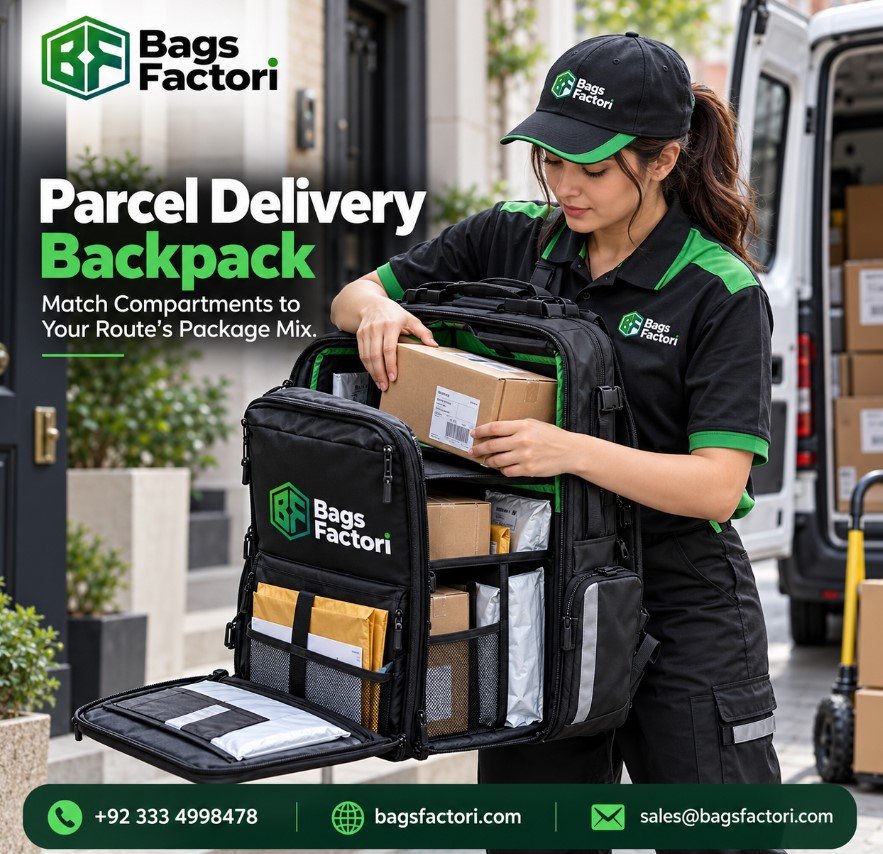
Choose a parcel delivery backpack using the route’s real mix of packets, cartons and collected returns. Confirm usable clearance, retrieval and loaded carrying before approving a bulk order. Pakistan courier fleets can avoid awkward compartments by trialing dispatch and several delivery stops together. A backpack with many pockets is not necessarily organized; the layout must help riders reach packages without damaging them or disrupting the remaining load.
Measure the Packages That Actually Share a Route
Gather representative packed parcels and record their dimensions and arrangements. Include the largest recurring carton, ordinary small packets and returned packages permitted by your process. Nominal backpack volume cannot reveal whether these shapes fit together. Outer dimensions also overlook the space taken by panels and partitions.
Ask for usable internal size and opening clearance. Check whether cartons can be inserted without angling them against the liner. Measure proposed compartments after the dividers are fitted. A large central cavity may be more useful than several narrow sections that cannot accommodate the actual package range.
The parcel delivery backpacks with configurable courier layouts page describes panels, straps and internal organization options. Confirm those features for the quoted model. General capacity or material descriptions do not establish one practical route load for every courier.
Define the Permitted Load and Exceptions
Agree the intended gross load with the supplier and your operating team. Record package arrangements that fit the design and how oversized parcels will be handled separately. Extra interior space should not become permission to overload. Trial the arrangement with intended users rather than interpreting a capacity label as a comfortable carrying limit.
Use Compartments to Improve Retrieval
A useful divider keeps package groups understandable without making every section inflexible. Trial the sample in dispatch order, then remove parcels as deliveries progress. Check whether small packets slide beneath remaining cartons. Observe whether inserts move or the main opening collapses when the load decreases.
Separate collected returns according to the operation’s defined procedure. Clear identification matters as much as the physical partition. Avoid creating an unnamed spare space that riders use inconsistently. The approved layout should explain where each group belongs and when another carrier is needed.
Compare courier delivery carriers for frequent-stop access and the courier and logistics bag category by handling role. A hand-carry or vehicle-stowed format may suit some routes better than a backpack. Select the carrying method before finalizing pockets and panels.
Evaluate Structure and Harness Together
Panels can preserve shape around cartons, while a base can help organize uneven packages. They also add weight and reduce flexibility. Choose their function explicitly. A rigid-looking body does not establish loaded balance, and soft sides may behave differently when only a few parcels remain.
| Component/material | Buyer benefit | Limitation | Sample or quality check | Specification to confirm |
|---|---|---|---|---|
| Oxford/polyester or nylon shell | Configurable weight and surface | Fabric name is not a bag strength rating | Inspect seams and rubbing points | Fabric construction and backing |
| Coated shell or tarpaulin | Addresses splash exposure | Openings can admit water | Inspect assembled closure | Coating, seams and exposure test |
| PP-board base or dividers | Supports load organization | Adds weight and reduces usable space | Check deflection and clearance | Placement and removability |
| Adjustable harness | Supports carrying fit | Capacity does not establish comfortable load | Trial representative parcels | Strap geometry |
| Reinforced webbing | Supports intended carrying layout | Anchoring affects stress distribution | Trial approved loaded sample | Webbing and attachment details |
The material and support options for delivery backpacks help identify shell and reinforcement questions. Confirm handle anchors and harness adjustment on the actual sample. Ask intended users to evaluate pickup, removal and carrying with representative parcels. Extra padding cannot reliably correct unsuitable loaded geometry.
Vehicle fittings require a separate fit evaluation. Backpack straps are not automatically mounting hardware. Specify the actual rack, attachment arrangement and loaded dimensions where relevant. Keep straps away from moving parts and follow the fleet’s applicable operating requirements.
Keep Identification Outside the Retrieval Path
Position route information where dispatch and receiving staff can read it without opening the carrier. An asset label identifies the backpack itself; a route label identifies the current assignment. Keep these understandable and visible under normal handling. Confirm whether scanning equipment can read the chosen label location.
A document pocket should serve an identified task. Do not add pockets merely to make the backpack appear more technical. Protect sensitive customer information from unnecessary exposure. Barcodes and windows support existing records but do not automatically create a tracking system.
Review e-commerce and 3PL carrier planning from hub to doorstep when defining these handoffs. A larger logistics carrier for parcel consolidation may handle the earlier stage, leaving the backpack focused on final delivery. Different network jobs can share branding without sharing every feature.
Check Shell Exposure and Maintenance Access
State whether the backpack is exposed outdoors or usually stored in a vehicle. Coated fabric may support splash resistance, but openings and seams also matter. Request suitable evidence for any whole-bag waterproof claim. Do not infer protection from a material name or a stock weather image.
Inspect corners, pockets and removable dividers during a maintenance trial. Obtain cleaning and drying instructions for the actual liner and hardware. Check how inserts are refitted and retained. Ordinary dry parcels generally require suitable support and organization rather than optional thermal layers intended for another application.
Compare Prices for the Same Route Layout
No current numerical parcel-backpack prices were available on the inspected page. Request PKR offers for identical internal dimensions, harness, panels, compartment layout and quantity. Include branding and destination. Separate sample, setup, carton, tax and freight charges so quotations describe the same project scope.
| Option/specification | Quantity or unit | Price in Rs./PKR | Main cost driver | Source/date |
|---|---|---|---|---|
| Small-packet backpack | Per bag; state identical-build quantity | Request current quotation | Dimensions and opening | Product page; 4 Oct 2026 |
| Mixed-carton backpack | Per bag; state identical-build quantity | Request current quotation | Base and partitions | Product page; 4 Oct 2026 |
| Fleet branded backpack | Per bag; state identical-build quantity | Request current quotation | Harness and artwork | Product page; 4 Oct 2026 |
| Sample, setup, packing and delivery | Itemized project quote | Request current quotation | Development and destination | Confirm in written offer |
Use the custom carrier manufacturing and sample approval process to discuss prototype revisions and inspection. Retain the approved configuration and representative package references. Review substitutions to panels or straps before assuming the later build preserves the tested fit and retrieval routine.
Frequently Asked Questions About Parcel Delivery Backpacks
1. Should we choose by backpack liters or parcel dimensions?
Use parcel dimensions and their actual arrangement as the main fit check. Volume does not reveal opening shape, compartment clearance or panel effects. Measure representative packed parcels and trial the sample. Record usable interior dimensions so procurement and dispatch refer to the same practical carrier configuration.
2. Are more compartments always better for a parcel route?
No. Extra divisions can reduce flexibility and prevent ordinary cartons from fitting. Choose sections that serve a clear retrieval or separation task. Simulate several stops and collected returns. A simpler cavity with well-planned grouping may work better than many pockets that do not match the package mix.
3. How should a large recurring carton be evaluated?
Check its packaged footprint, opening clearance and position with the other permitted parcels. Do not test it alone if it normally shares the load. Evaluate closure, base support and retrieval without forcing the carton. Define when larger exceptions require a different carrier rather than changing the approved packing arrangement.
4. What happens to organization as the backpack becomes empty?
The shape, divider position and package support may change as parcels leave the bag. Trial partial loads and later delivery stops. Observe small packets and closure alignment. An arrangement that looks organized when full may need adjustment to remain practical without improvised filling or repeated repacking.
5. Should returns have a separate backpack compartment?
Use the operation’s defined returns procedure to decide. A clearly identified section or separate carrier may be appropriate. Check that the layout preserves usable clearance for outbound parcels. The compartment supports organization, but route records and staff instructions are still needed to prevent assignment mistakes.
6. Does a structured body guarantee comfortable carrying?
No. Comfort depends on harness geometry, adjustment, user and load placement. Panels help shape but add weight. Trial the loaded sample with intended riders through ordinary pickup and carrying. Treat interior capacity separately from suitable carrying weight and avoid assuming extra padding solves an awkward package arrangement.
7. Can the backpack be mounted with its shoulder straps?
Do not assume so. Mounting requires an appropriate arrangement for the actual rack, fittings and loaded configuration. Specify that requirement separately and evaluate fit. Keep attachments clear of moving parts. A photograph of a backpack on a motorcycle does not establish compatibility with your fleet’s setup.
8. Does an outer coating make the completed backpack waterproof?
No. Seams, zippers, flaps and pockets also influence ingress. State expected exposure and obtain suitable construction and testing evidence for the claim. A coated shell can support splash resistance, but it should not be promoted as assurance that all parcels stay dry under every route condition.
9. How should courier backpack quotations be compared?
Compare the same usable dimensions, panels, harness, dividers, closures and branding at stated quantities. Include sample and setup costs, cartons, tax and destination delivery. Different layouts describe different products even when called parcel backpacks. Evaluate the project total alongside the loaded sample’s retrieval and carrying performance.
10. What should we send with a parcel backpack inquiry?
Send package dimensions, representative route arrangement, intended gross load, carrying routine, exposure and returns requirements. Include quantity, artwork, labels and destination. Request sample terms, component details and an itemized PKR offer. Confirm MOQ and production dates after approving the layout that fits the actual parcel mix.
Request a Backpack for the Route You Operate
Use packaged-parcel trials to confirm the cavity, retrieval and harness together. Send measurements, quantity, branding, destination and route needs through custom parcel backpack design and quotation support. Retain the approved sample and loading references before extending the purchase across the fleet.