Delivery Bag Materials Guide: Fabric, Insulation, Lining and Hardware
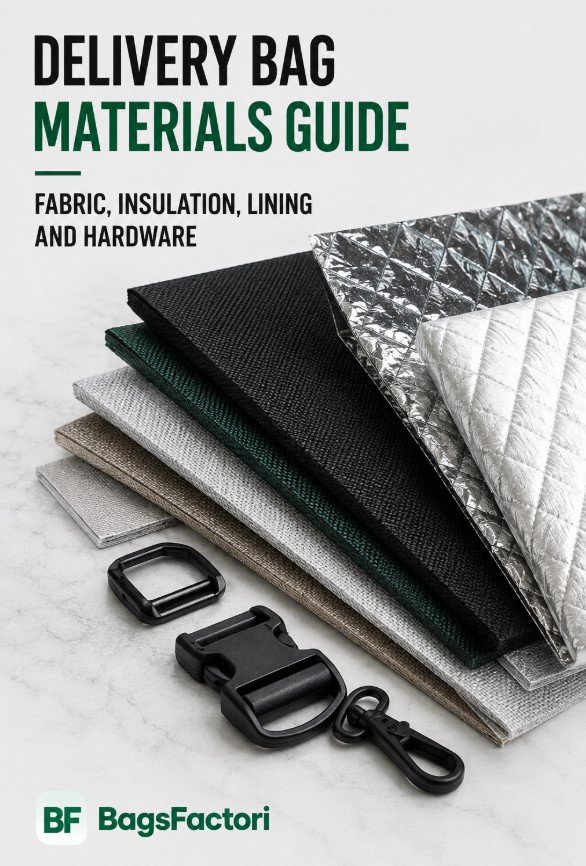
The performance of a commercial delivery bag depends on much more than its appearance. Outer fabric affects abrasion and weather resistance; insulation influences thermal transfer; lining affects cleaning; structural panels control shape; and hardware determines how well the bag survives repeated opening, lifting and carrying.
For B2B procurement teams, understanding Delivery Bag Materials makes it easier to compare factory quotations and avoid buying two bags that appear similar but are constructed to completely different quality levels.
Delivery Bag Material and Quality Comparison
| Component | Material | Typical Quality Level / Benefit |
| Outer Fabric | 600D Oxford | Strong general-purpose commercial option |
| Outer Fabric | 1680D Oxford | Heavy-duty abrasion-resistant option |
| Outer Fabric | PVC Tarpaulin | High water resistance and easy exterior cleaning |
| Insulation | PE/EPE Closed-Cell Foam | Common thermal core |
| Thermal Layer | Aluminum/Reflective Foil | Helps reduce radiant heat transfer |
| Interior | PEVA / wipe-clean liner | Cleaning-friendly inner surface |
| Structure | PP Board | Supports walls and shape |
| Webbing | Polyester/Nylon webbing | Handles and straps |
| Closure | Heavy-duty zipper | Repeated commercial access |
| Visibility | Reflective material | Rider visibility feature |
600D Oxford Fabric
600D Oxford Delivery Bag fabric is widely used because it offers a practical balance between durability, weight, printability and manufacturing cost.
The “D” refers to denier, which relates to yarn mass rather than being a direct universal measure of finished fabric strength. Two 600D fabrics can therefore perform differently depending on yarn quality, weave, coating and finishing.
Procurement teams should not evaluate fabric only by the “600D” label.
1680D Oxford for Heavy-Duty Applications
1680D Oxford Fabric is often selected for delivery bags expected to face heavier abrasion and intensive daily use.
It can be appropriate for professional rider fleets, courier operations and premium delivery equipment. However, higher denier also affects weight and cost, so using the heaviest available material is not automatically the best solution.
The goal is to match construction to the operating environment.
PVC Tarpaulin
PVC Tarpaulin Delivery Bags are useful where water resistance and easy exterior cleaning are important.
The smooth surface can perform well in rain-prone delivery environments and commercial operations exposed to frequent spills.
However, buyers should evaluate flexibility, weight, odor requirements, temperature conditions and relevant material regulations for the destination market before finalizing a specification.
PE and EPE Foam Insulation
The insulation core creates resistance to heat transfer between the contents and surrounding environment.
PE/EPE Foam Insulation is commonly used in thermal delivery products because it is lightweight and can be produced in different thicknesses.
Thermal performance depends not only on foam thickness but also on seams, closures, internal air space, opening frequency, ambient conditions and the temperature of products when loaded.
Aluminum and Reflective Thermal Lining
Reflective foil layers are commonly paired with foam in Insulated Delivery Bags.
They contribute to thermal construction and can provide a practical interior surface depending on the exact laminate.
Buyers should distinguish between thin decorative foil and properly specified commercial lining systems when comparing quotations.
Food-Safe and Wipe-Clean Liners
For food-related applications, interior surfaces should be appropriate for the intended use and easy to maintain.
A Wipe-Clean Delivery Bag Liner simplifies routine cleaning after condensation or accidental spills.
When specific food-contact, chemical or regulatory requirements apply, buyers should request the appropriate material documentation from their supplier rather than relying solely on marketing terminology.
PP Board and Structural Panels
Soft bags may collapse when empty or allow contents to move excessively. PP Board Reinforcement can be inserted into walls or bases to create a more stable structure.
Structured bags are particularly useful for rider backpacks, stacked meal containers and applications where maintaining a predictable internal shape is important.
The thickness and location of panels should be matched to expected load.
Zippers, Webbing and Buckles
Hardware is one of the most important—and frequently overlooked—parts of a commercial bag.
A premium exterior fabric provides little benefit if a zipper fails early or handle stitching separates under load.
B2B buyers should therefore inspect zipper size, slider quality, webbing width, reinforcement stitching, buckles and strap attachment points during sample approval.
2026 Delivery Bag Material Price Comparison
Because manufacturers usually quote complete bags rather than raw material components, the following table compares typical finished-bag market positioning associated with common material specifications.
| Construction | Indicative 2026 Finished Bag Range | Positioning |
| Lightweight Thermal Construction | Rs.200–Rs.500 | Entry-level wholesale |
| 600D Oxford + Foam + Foil | Rs.400–Rs.1000 | Standard commercial |
| 600D Structured Commercial Bag | Rs.600–Rs.1500 | Restaurant/fleet use |
| 1680D Heavy-Duty Construction | Rs.1000–Rs.2500+ | Intensive professional use |
| PVC Tarpaulin Custom Bag | Rs.800–Rs.2500+ | Water-resistant professional applications |
| Specialist Medical/Cold-Chain Construction | Quote Based | Performance-specific applications |
Market prices vary substantially by dimensions, insulation thickness, order quantity, branding, hardware, country of origin and freight.
Current 2026 wholesale listings demonstrate this variation: basic high-volume thermal products can be offered at only a few dollars per unit, while more substantial 600D Oxford promotional products can exceed $10–$15 per unit at lower quantities.
How to Compare Two Factory Quotations
Never compare quotations using price alone.
If Supplier A quotes a 600D bag and Supplier B also quotes “600D,” the products are not necessarily identical. Ask about coating, foam thickness, liner, base reinforcement, zipper, webbing, stitching, printing, packaging and dimensions.
Create one written specification and ask every shortlisted manufacturer to quote against exactly the same requirements.
This turns price comparison into a meaningful procurement exercise.
Choose Materials According to Application
A restaurant making short urban deliveries may require 600D Oxford Food Delivery Bags, while a motorcycle fleet operating in wet conditions may benefit from a different exterior.
Pizza delivery requires horizontal stability. Courier bags prioritize durability and organization. Frozen-food and cold-chain applications focus more heavily on thermal systems. Medical transport may involve additional regulatory requirements.
There is therefore no single “best delivery bag material” for every application.
Related Products and Material Guides
- Custom Pizza Delivery Bags with Commercial Thermal Insulation
- Cold Chain Bags for Temperature-Sensitive Delivery Operations
- Frozen Food Delivery Bags for Commercial Distribution
- Pharmaceutical and Medical Courier Bags for Healthcare Logistics
- Delivery Bag Manufacturing Process for OEM and ODM Buyers
Material Selection for OEM/ODM Orders
For OEM Delivery Bag Manufacturing, buyers should specify materials rather than requesting only “high quality.”
A stronger RFQ might state: 600D Oxford exterior, closed-cell foam insulation, wipe-clean interior, PP board base, reinforced webbing handles and custom screen-printed logo.
The manufacturer can then recommend adjustments based on application and budget.
For buyers unsure about construction, an ODM approach can use an existing design as the starting point before materials and branding are customized.
Sample Testing and Quality Control
Before approving bulk production, inspect the physical sample.
Check fabric feel, dimensions, zipper movement, stitching consistency, handle reinforcement, liner installation, insulation, panel stability and logo quality.
Load the sample with the approximate real-world weight and packaging it will carry. Open and close it repeatedly and evaluate how easily the interior can be cleaned.
This practical test provides much more useful information than evaluating photographs alone.
Frequently Asked Questions About Delivery Bag Materials
What is the best material for food delivery bags?
600D Oxford fabric is one of the most common choices for commercial food delivery because it balances durability, weight and price. Heavy-duty or wet environments may justify 1680D Oxford or PVC tarpaulin.
Is 1680D better than 600D Oxford?
1680D is generally positioned as a heavier-duty option, but “better” depends on application. A lighter 600D construction may be more appropriate when weight and cost matter.
What insulation is used inside delivery bags?
Closed-cell PE or EPE foam is commonly used, often combined with reflective foil or another thermal liner.
What makes a delivery bag waterproof?
Outer material, coating, seams, zippers and closures all matter. A water-resistant fabric alone does not automatically make the entire assembled bag fully waterproof.
What is PP board used for?
PP Board can reinforce the base and side walls so a delivery bag retains its structure and supports packaged contents.
Which lining is easiest to clean?
Smooth, wipe-clean liners such as appropriate PEVA or laminated thermal surfaces can simplify maintenance. Exact material selection should match the intended application.
Do thicker materials always mean better quality?
No. Quality also depends on yarn, coating, stitching, hardware, liner, structural design and manufacturing consistency.
How should B2B buyers specify delivery bag quality?
Create a written specification covering dimensions, exterior fabric, insulation thickness, liner, structure, zippers, webbing, stitching, branding, packaging and intended load. This provides a much stronger basis for quotations and quality control than simply requesting a “premium delivery bag.