

Choosing between PEVA vs aluminum foil insulated bags starts with understanding what is actually being supplied. These names describe possible lining materials, while a finished carrier also contains insulation, an outer shell, closures and structural components. A convincing sample should demonstrate how those elements work together around your packaged orders. For restaurant chains and distributors, that is more useful than choosing the shiniest interior.
The purchasing decision should connect material identification with handling, maintenance and repeat production. Define the required construction, review a complete sample and retain an approved specification. Then future quotations can refer to the same product instead of a loosely described “thermal bag.”
PEVA Liner Specifications for Custom Insulated Bags
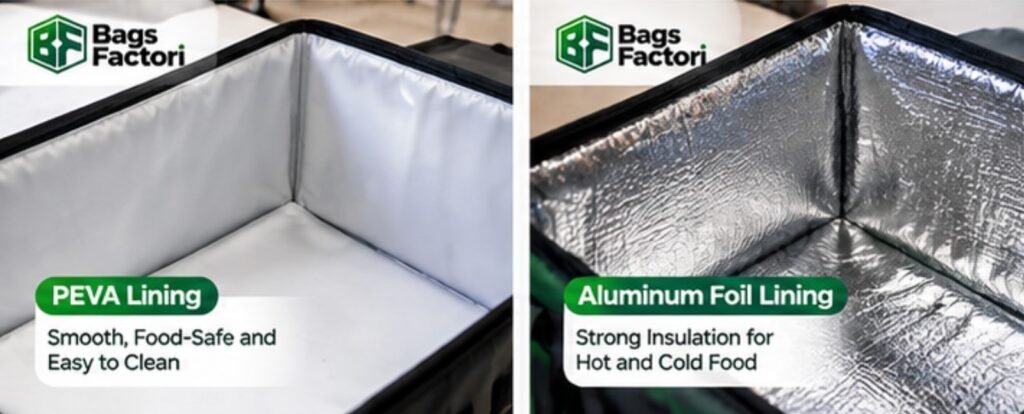
PEVA is commonly used in bag descriptions for polyethylene vinyl acetate material associated with the ethylene vinyl acetate polymer family. EVA itself is a copolymer made from ethylene and vinyl acetate. However, a commercial PEVA label does not identify every ingredient, thickness or finished-film property. Ask the supplier to identify the actual lining grade and construction rather than treating the acronym as a full specification.
A PEVA film liner may be considered where a flexible inner surface is useful. Its suitability still needs to be checked in the assembled carrier, including its corners, attachment method and contact with packaging. A material swatch cannot reveal whether the finished interior gathers awkwardly at the base or makes containers difficult to remove. Request both material information and a finished sample.
PEVA availability should also be confirmed before a buyer builds a quotation around it. BagsFactori’s public information discusses aluminum thermal lining and wipe-clean liner options, but the reviewed pages do not establish a particular PEVA product offering. Use the insulated bag lining materials and construction as a starting point for questions, then confirm the proposed liner in writing.
Aluminum Foil Laminate and Metallized Film Linings
“Foil lining” needs clarification because a silver appearance does not establish the material underneath. An actual aluminum foil laminate includes a metal foil layer combined with other materials. A metallized film instead has a thin deposited metal layer on a plastic substrate. Both can look reflective, but they should not be recorded as interchangeable specifications.
Request the layer description, thickness information and exposed inner surface. Determine whether the aluminum is protected by another film and how the layers are bonded. These details help explain what staff will touch, wipe and bend during use. They also make it easier to identify an unapproved material substitution in a later batch.
Do not confuse an inner bag lining with household kitchen foil. A delivery carrier requires a construction suitable for sewing, joining, repeated loading and maintenance. A buyer should evaluate the finished laminate supplied for that purpose, rather than transferring assumptions from a roll of food wrapping foil.
PEVA vs Aluminum Foil Insulated Bags at a Glance
| Material or construction | Practical benefit | Limitation | Suitable use | What the buyer should verify |
| PEVA film liner | Flexible inner surface | Grade and joining details vary | Packaged orders where the sample meets handling needs | Composition, thickness, seams and cleaning instructions |
| Aluminum foil laminate | Reflective layer within a composite | Bonding and exposed surface need assessment | Thermal carriers with a verified complete build | Layer structure, backing and flex durability |
| Metallized plastic film | Reflective finish on a plastic substrate | Silver appearance does not prove actual foil | Designs specifying that exact film | Substrate, coating and protective layer |
| Complete insulated carrier | Combines lining with insulation and closures | Performance depends on the full configuration | Defined restaurant or distributor programs | Usable fit, approved loading and relevant test evidence |
The table is a purchasing framework rather than a ranking. Two products carrying the same lining label may use different backing, seams and foam. Compare complete configurations against a shared brief before assigning value to a material name.
Insulated Bag Lining and Complete Bag Heat Retention
Insulation can slow heat transfer, and reflective surfaces can influence radiant transfer under suitable conditions. Reflective performance depends on the surrounding arrangement, including an appropriate air space. A silver liner pressed against a container should not be assumed to provide the same thermal effect as a reflective surface facing open space. Building-insulation principles explain the mechanism but do not certify a delivery bag’s performance.
For procurement, ask how insulation is arranged across the base, sides and lid. Inspect whether closures leave gaps and whether structural parts compress the insulating layer. Record the loaded configuration, starting conditions, journey duration and opening routine when arranging a thermal evaluation. A supplier’s unexplained “hours hot” claim is insufficient evidence for your route.
If comparing two liners, keep other design variables equivalent where practical. Otherwise, a difference in foam, loading or closure may be mistaken for a lining advantage. Ask the supplier to explain any unavoidable differences before interpreting the results. The useful conclusion concerns the tested bag configuration, not every product made from the material.
Cleaning Access in Custom Insulated Bags
An easy-to-reach interior matters as much as a smooth-looking film. Open the sample fully and check whether staff can access the base corners, underside of the lid and areas behind inserts. Removable components should be assessed with the supplier’s instructions, including how they are reinstalled. Avoid designing pockets or supports that make ordinary maintenance unnecessarily difficult.
Request approved cleaning products, methods and drying instructions for the exact build. Do not assume a liner tolerates soaking, machine washing, aggressive disinfectants or high heat. The joins, foam, adhesives and structural panels may require different care from the exposed film. A clear maintenance procedure helps branches use the carrier consistently.
Consider how cleaning records will work across a fleet. Give each model a matching care instruction instead of one generic statement for every bag. When liners or backing materials change, review those instructions again. That prevents a purchasing change from silently creating a maintenance problem.
PEVA Liner and Foil Laminate Wear Checks
Inspect the parts of the sample most likely to contact box edges and tray corners. Look for loose folds, exposed edges and areas where inserts rub against the liner. Repeat ordinary loading and removal with representative sealed packaging. Record visible changes rather than trying to predict service life from a quick hand inspection.
For laminated materials, ask how the supplier evaluates layer separation and repeated flexing. For a flexible liner, ask how attachments and seams are checked. Neither question establishes that one material always lasts longer. They identify the construction details that need evidence for the proposed use.
When a distributor plans several sizes, review more than the easiest model. A larger opening, deeper body or differently placed support may change how the same lining behaves. Use OEM and ODM delivery bag development to discuss the sample scope before confirming a range.
Insulated Bag Linings and Direct Food Contact
Carrying sealed meal containers is different from placing unwrapped food against a bag liner. Do not infer suitability for direct food contact from a material name or the phrase “food delivery.” If direct contact is intended, ask for documentation applying to the exact finished material, food type and conditions of use. Applicable requirements depend on the destination market and intended application.
The liner also does not replace appropriate food packaging or the restaurant’s temperature procedures. Keep the carrier’s role clear in staff instructions. It provides an outer transport environment around properly prepared and packaged orders. Any required temperature performance must be established for the complete operation.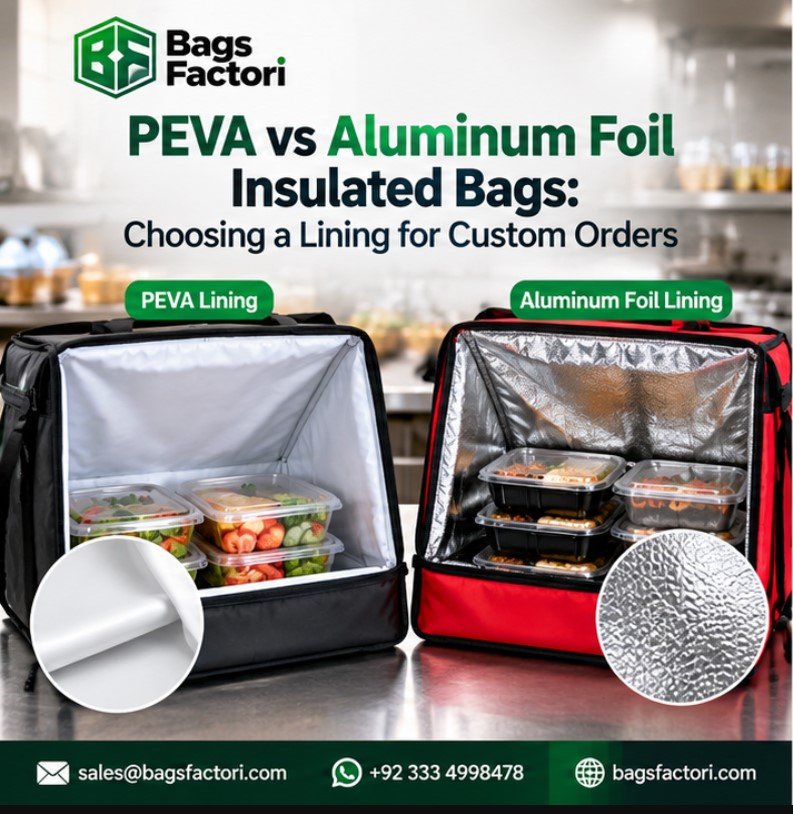
Custom Thermal Bag Materials Approval Brief
Before requesting custom insulated food delivery bags, assemble the information that allows a supplier to propose a meaningful configuration. Include the packaging arrangement and maintenance routine, not just the desired color. Your brief should cover:
- Identified lining material, layer structure and permitted substitutions.
- Insulation, outer fabric, closures and structural components.
- Usable dimensions and representative sealed packaging.
- Cleaning method and areas staff must reach.
- Sample acceptance checks and any thermal evidence required.
- Quantity by model, branding, destination and repeat-order expectations.
Keep a reference sample and written revision record after approval. Link the purchase order to that revision so the lining cannot change without discussion. Buyers planning resale can also review wholesale insulated bag supply inquiries when deciding how models and packaging will be identified.
FAQs about Insulated Bag Linings
Is PEVA better than foil for custom insulated bags?
Neither name establishes a universal winner. Evaluate the exact liner, supporting insulation, closures, cleaning access and packaged load. A construction that suits a hand-carried meal bag may need changes for a large rider carrier. Compare complete samples against the same operational requirements before approving the material.
Does every silver lining contain aluminum foil?
No. A silver finish may come from metallized plastic film rather than a metal foil laminate. Ask for the layer structure and substrate identification. Appearance alone cannot confirm what has been supplied. Record the agreed construction so later batches can be checked against it.
Can we specify only the lining and leave the rest to the factory?
That leaves important performance and cost variables unresolved. At least define packaged dimensions, handling needs, insulation, closures and cleaning expectations. The supplier can recommend details within that brief. Record the final configuration after sample review so the order refers to an agreed product.
Should the bag be tested empty or loaded?
An empty inspection helps identify workmanship and access issues. A loaded assessment shows fit, handling and the actual transport arrangement. Thermal evaluation should use defined representative conditions, including payload and opening routine. Neither an empty visual check nor a material swatch demonstrates real-route performance.
Does a food-contact document cover every liner sold under the same name?
Do not assume that it does. Ask which material, supplier and use conditions the document addresses. Check whether it applies to the finished construction and intended contact. For market-specific compliance decisions, have the responsible procurement or compliance person review the evidence before approving the application.
How can repeat orders retain the approved lining?
Use a named specification revision, retained sample and written substitution procedure. Require the supplier to identify proposed changes before production. Compare incoming units with the reference configuration. This creates a clearer basis for resolving differences than a purchase order describing only a “foil insulated bag.”
Conclusion: Choosing PEVA vs Aluminum Foil Insulated Bags
The better lining is the one supported by a clear material description and a satisfactory complete-bag sample. Compare the approved construction, cleaning access and packaging fit before committing to custom production.
Prepare your packaging dimensions, lining questions, cleaning requirements and quantity by model. Use custom insulated bag specification inquiry to discuss available constructions and sample terms. Approve the lining as part of a complete carrier that your team has evaluated for its intended work.