
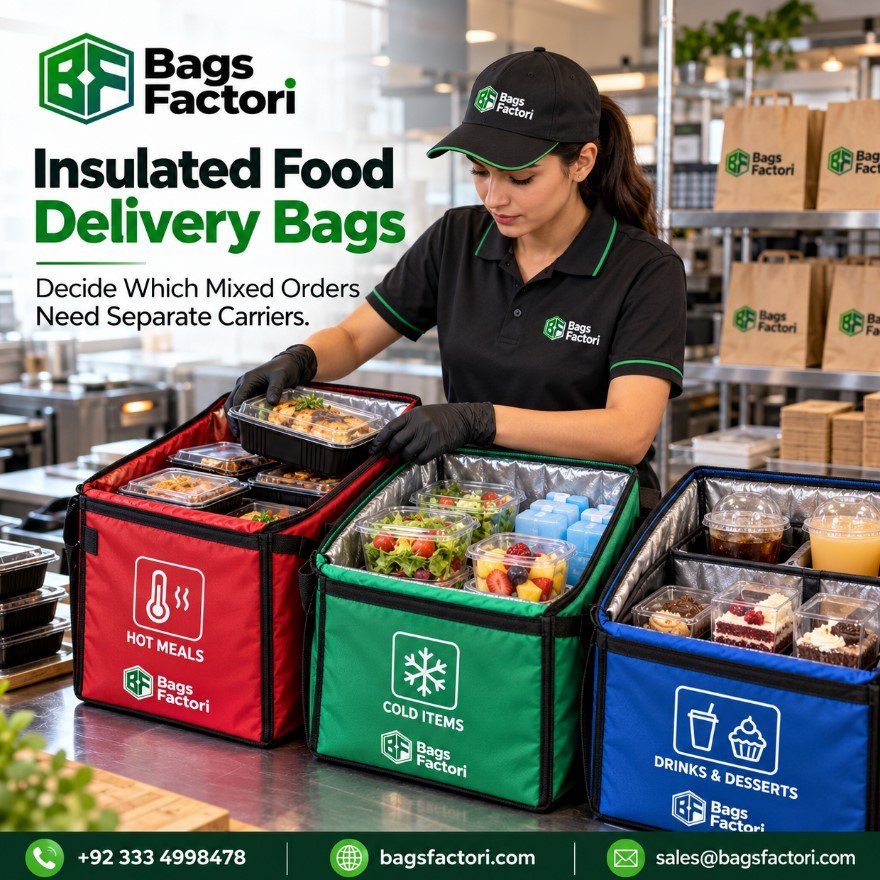
Choose insulated food delivery bags by grouping your menu according to packaging, handling and temperature requirements before selecting the carrier. A hot meal, cold drink and fragile dessert may need different arrangements even when they belong to one customer order. Pakistan cloud kitchens should test the complete dispatch routine, then specify compartments or separate bags where appropriate. Buying one large carrier without this planning can make loading and handover unnecessarily complicated.
Map the Menu into Practical Delivery Groups
List the packaged items regularly dispatched together. Measure meal cartons, drink holders, dessert boxes and outer bags, including lids and closures. Identify items that need level handling or protection from neighboring packages. Keep their primary packaging requirements separate from the reusable carrier specification.
Next, identify temperature requirements through the responsible food-handling team. A removable divider organizes space but does not create independent thermal zones. Decide which combinations can share an arrangement and which need separate carriers. Record those rules so kitchen staff can reproduce them at busy dispatch periods.
The insulated thermal food delivery bags for custom menu layouts page describes customizable structure, dimensions and compartments. Confirm the proposed build against your menu groups. A general statement about carrying hot and cold goods does not demonstrate suitability for mixing them in one load.
Design for Ordinary Orders and Planned Exceptions
Measure everyday combinations first, then identify larger orders that occur frequently enough to justify another model. A single oversized carrier may be inefficient for small meals and awkward on the vehicle. Assign carrier sizes to clear order types. Staff should know when an exception needs a second bag instead of forced loading.
Choose Organization That Helps the Next Handover
Place orders according to dispatch and delivery sequence while maintaining package support. Small sauce packs and documents may need an accessible location, but do not let extra pockets crowd the main cavity. Check whether a removable partition moves when adjacent cartons are taken out. Organization should still function when the bag is partly empty.
Drinks need suitable sealed packaging and holders. A side compartment may reduce contact with cartons, but it does not guarantee spillproof transport. Confirm how the rider removes beverages without reaching over delicate meals. Evaluate the combination with the actual cup carrier and packaging used by the kitchen.
Compare burger delivery carriers for combo-meal arrangements and catering bags for larger covered trays where those formats better match recurring orders. Choosing a specific carrier can simplify a task that a general multi-menu bag struggles to handle.
Select the Construction Around the Loading Arrangement
BagsFactori publishes shell, thermal lining, foam and structural options for food carriers. The actual assembly should be confirmed on the approved sample. Soft-sided, panel-supported and framed configurations can differ in weight, folding and usable space. Do not compare their prices as if they describe one equivalent product.
| Component/material | Buyer benefit | Limitation | Sample or quality check | Specification to confirm |
|---|---|---|---|---|
| Oxford/polyester or nylon shell | Configurable weight and surface | Fabric name is not a bag strength rating | Inspect seams and rubbing points | Fabric construction and backing |
| PE/EPE foam assembly | Slows heat exchange | Needs complete packout testing | Inspect continuity and trial load | Layer arrangement and thickness |
| Reflective/wipe-clean lining | Supports interior maintenance | Corners can trap residue | Reach seams and folds | Liner and compatible cleaners |
| PP-board base or dividers | Supports load organization | Adds weight and reduces usable space | Check deflection and clearance | Placement and removability |
| Drink holder or partition | Separates packed menu items | Does not guarantee spill or thermal isolation | Trial complete mixed order | Compartment dimensions |
Use the delivery bag materials and quality information to prepare component questions. Ask how the liner, inserts and closures are maintained. A shell coating is not proof of whole-bag waterproof construction, and a reflective lining alone cannot establish a guaranteed arrival temperature.
Check filled-carton support and how staff lift the carrier. Define the intended gross load and handling method. A wide opening can be valuable for awkward packaging, while an unnecessarily deep body can hide small orders. Use the sample to verify the actual arrangement rather than approximate interior volume.
Trial Hot, Chilled and Fragile Configurations Separately
Evaluate representative meals using the operation’s food-handling requirements and route conditions. Include waiting before dispatch and realistic access events. Check presentation, package movement and appropriate temperature criteria. Record which carrier and packing arrangement produced each observation.
Where chilled or frozen products require a complete thermal system, review cold-chain bags for specified packout development. Keep required coolant, protective packaging and validation separate from ordinary hot-meal insulation. A menu-wide carrier claim should not replace application-specific evaluation.
For delicate desserts or bakery products, inspect lid contact, base deflection and removal access. A carrier may provide enough space while still permitting cartons to lean. Adjust the structure or use another format if staff cannot maintain the intended arrangement. Do not advertise a bag as universally suitable based on one meal trial.
Keep the Cleaning and Dispatch Routine Manageable
Complex layouts create more corners and attachment points to inspect. Ask staff to remove inserts and clean the sample using the agreed procedure. Confirm compatibility, drying and reassembly. A layout that helps organization but slows maintenance excessively may need simplification.
The cloud-kitchen bag program page for delivery-only operations connects carrier design with repeated dispatch. Standardize instructions alongside the physical bag. Record approved order groups, loading sequence and any restricted combinations so the arrangement survives shift changes and branch expansion.
Compare Quotes by Menu Configuration
Current numerical food-bag prices were not available on the reviewed product page. Request PKR offers for each defined model with identical dimensions, panels, thermal assembly, compartments and branding. Include the destination and quantities per model. Ask whether mixed sizes or artwork versions change order minimums.
| Option/specification | Quantity or unit | Price in Rs./PKR | Main cost driver | Source/date |
|---|---|---|---|---|
| Compact mixed-meal carrier | Per bag; state identical-build quantity | Request current quotation | Internal arrangement | Product page; 4 Oct 2026 |
| Structured multi-order carrier | Per bag; state identical-build quantity | Request current quotation | Panels and partitions | Product page; 4 Oct 2026 |
| Separate thermal configurations | Per bag; state identical-build quantity | Request current quotation | Packout and insulation | Product page; 4 Oct 2026 |
| Sample, setup, packing and delivery | Itemized project quote | Request current quotation | Development and destination | Confirm in written offer |
The OEM and ODM bag design and production process supports a discussion about samples and repeat supply. Confirm setup, packing, tax and delivery inclusions. Retain the approved arrangement so later orders can be compared without relying on a broad product name.
Related Products and Reading
- Burger carriers for organized combo-meal loading
- Catering carriers for tray-based restaurant orders
- Bag programs for cloud kitchens and delivery apps
Frequently Asked Questions About Mixed-Menu Delivery Bags:
1. Can one insulated bag serve an entire restaurant menu?
It may serve several defined configurations, but not every menu automatically. Packaging shapes, fragile items and temperature requirements differ. Map common orders and trial them separately. A small carrier range may be more practical than one oversized model. Record which arrangements are approved for each bag and route.
2. Do dividers create separate hot and cold zones?
Not automatically. They organize space and may reduce contact, but thermal separation needs suitable design and evidence. Determine the required arrangement with your food-handling team. Separate carriers may be necessary. Do not infer independent temperature control because a supplier offers removable partitions or a drink compartment.
3. How should meal containers be measured for a shared carrier?
Measure the complete dispatched combination, including sealed lids, outer bags, drink holders and sauces. Record its layout and stacked height. Ask for usable clearance after lining and inserts. Trial loading, closing and removal rather than adding individual package volumes and assuming the result establishes practical fit.
4. Are drink holders inside the bag spillproof?
A holder can support appropriate packaging, but it does not guarantee spill prevention. Check the sealed cups, holder fit and movement during the sample trial. Evaluate how drinks are removed at handover. Decide whether your routine needs a distinct beverage compartment or separate carrier for particular orders.
5. When is a catering carrier better than a general food bag?
Consider it when covered trays, larger footprints or multiple supported levels are recurring requirements. A general meal carrier may not provide useful opening clearance or shelf support. Compare actual tray loading and agreed weight. Choose the format through the operation rather than the similarity of product names.
6. Does a frame automatically improve food delivery?
A frame may preserve shape, but it adds weight and can affect packing, storage and usable dimensions. Supported panels or a softer arrangement may suit other menus. Trial the actual order and staff handling. The useful construction is the one that solves a defined packaging or loading problem.
7. What should a mixed-menu sample evaluation record?
Record the carrier build, packaged order arrangement, loading effort, closure operation, movement and retrieval. Include representative route conditions and requirements set by the responsible team. Evaluate distinct menu configurations separately. Document changes before approval so the sample and operating instructions refer to the same arrangement.
8. How can several kitchens keep the loading routine consistent?
Use a shared specification and clear instructions for approved order groups, divider positions and loading sequence. Retain photographs of permitted arrangements. Review packaging changes across branches before assuming fit remains unchanged. Staff should know when another carrier is required rather than improvising under dispatch pressure.
9. What costs should be compared for multiple carrier models?
Compare unit prices by approved model and quantity, then include samples, setup, artwork versions, cartons, taxes and destination delivery. Ask whether combined quantities affect minimums. Different structures and compartments should not be compared as one generic bag price. Evaluate the project total alongside usable performance and maintenance needs.
10. What should we provide with a mixed-menu quotation request?
Provide packaged menu combinations, dimensions, temperature and handling requirements, intended load and delivery routine. State quantity per model, artwork, cleaning needs and destination. Request sample terms and an itemized PKR offer. Confirm the approved configurations and production dates before rolling the range out across kitchens.
Request a Carrier Range That Matches Your Menu
Define the ordinary orders, identify combinations needing separation and test the proposed layouts. Send packaging measurements, quantity by model, branding and destination through custom food carrier design and quotation support. Approve the construction together with practical loading instructions before expanding the program.