
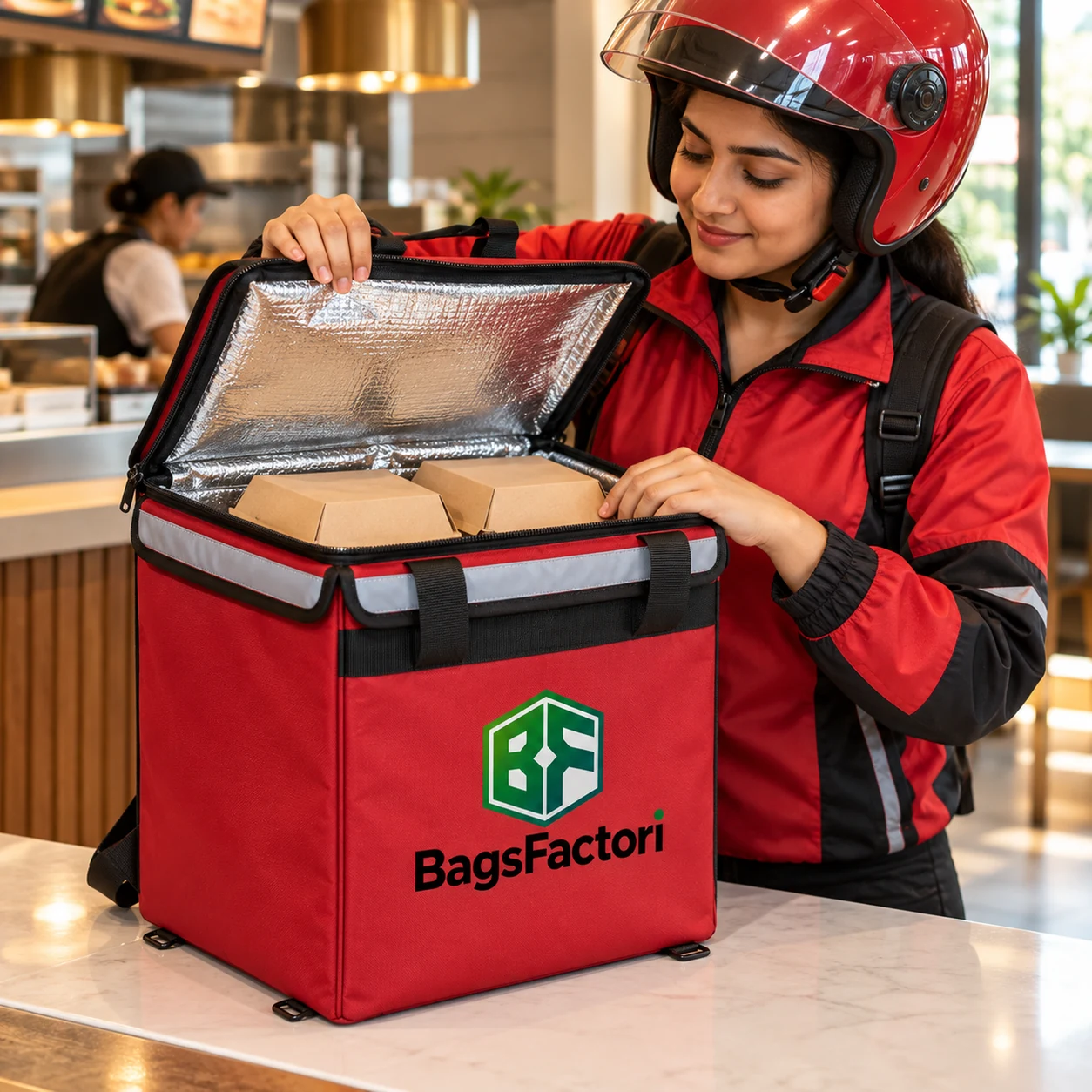
Choose burger delivery bags by measuring your complete packed order, checking usable internal space and testing a loaded sample. The bag should let staff insert boxes easily, keep drinks organized and close without pressing down on food packaging. Compare insulation, cleaning access and carrying method only after confirming that fit. For restaurants buying in bulk in Pakistan, this sequence helps prevent a branded carrier from becoming an awkward part of every delivery.
Start with the Packed Meal, Including Its Outer Packaging
Measure boxes after staff have filled and closed them. Include projecting lids, paper-bag folds, cup carriers and any protective wrapping. Record the footprint and total height of the arrangement you actually send out. Changing to a new box supplier later may change the bag fit even when the menu stays the same.
Ask for usable internal dimensions, including the effect of lining, insulation, dividers and structural inserts. External measurements describe the outside of the bag and cannot establish whether a meal fits. Check the opening as well: a generous interior is difficult to use if a narrow zipper entrance forces staff to tilt boxes.
Check the Whole Loading Arrangement
For available development options, review burger delivery bags for restaurant and fleet orders. BagsFactori’s published page describes customized dimensions, insulation and carrying layouts; the exact combination needs confirmation in your quotation.
Choose the Carrying Style Around the Delivery Workflow
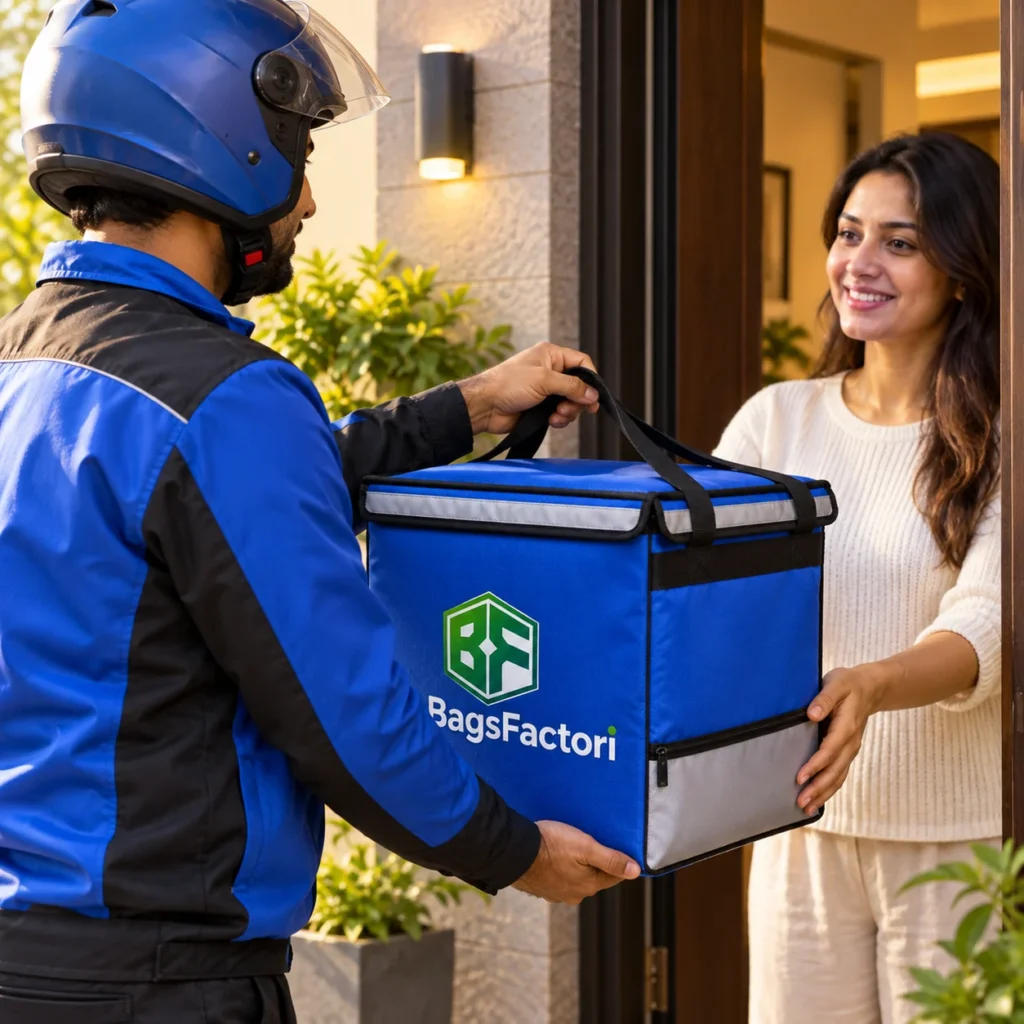
A hand-carry model can suit transfer from a kitchen to a vehicle and doorstep handover. It needs handles that remain accessible when the carrier is full. A backpack may be useful where riders regularly carry the bag between pickup points and customers. Its depth, back support and loaded balance deserve as much attention as its appearance.
Do not assume one large backpack is suitable for every rider or every route. Ask staff to evaluate the sample using a representative load and normal pickup routine. Vehicle-mounted arrangements need a separate fit check against the actual rack and mounting design. Loose straps should not interfere with the vehicle’s moving parts.
Compare rider backpack bags with customizable food compartments where backpack carrying is required. For restaurant groups with broader menus, the insulated thermal food delivery bag category shows related formats. Choosing two appropriate sizes may be more practical than buying one oversized model for all orders.
Compare Materials by the Problem They Solve
BagsFactori lists polyester, nylon, coated fabrics, tarpaulin, EPE foam and reflective lining among its burger-bag manufacturing options. Treat these as configurable choices rather than features guaranteed in every bag. Specify the complete assembly, including reinforcement and closures, before comparing supplier prices.
| Component/material | Buyer benefit | Limitation | Sample or quality check | Specification to confirm |
|---|---|---|---|---|
| Polyester or nylon shell | Flexible branded exterior | Fabric name alone does not establish wear resistance | Inspect surface, seams and rubbing points | Fabric construction and coating |
| Coated fabric or tarpaulin | Helps address splashes and surface cleaning | Seams and openings may admit water | Evaluate the assembled carrier under intended exposure | Coating, seam and closure construction |
| EPE foam with reflective lining | Can slow temperature change | Performance depends on the complete load and route | Trial representative packed meals | Layer construction and thickness |
| Wipe-clean inner surface | Makes spills easier to access | Folds and seams may trap residue | Reach into corners and behind dividers | Lining and compatible cleaning method |
| PP board or reinforced base | Supports cartons during movement | Adds structure, weight and packing volume | Observe loaded base deflection | Insert placement and removability |
| Zipper or covered flap | Controls loading access and closure | Tight corners or trapped fabric slow use | Open and close repeatedly with the bag loaded | Hardware and opening dimensions |
Use the delivery bag materials and quality information to prepare questions about these options. Stronger-looking fabric cannot compensate for a weak handle attachment or an opening that does not fit your packaging.
Balance Warmth, Meal Presentation and Drink Separation
An insulated carrier can slow heat exchange, but the delivered result depends on food, primary packaging, dispatch delays, outside conditions and repeated opening. Test the actual meal combination on a representative delivery journey. Evaluate presentation as well as warmth, especially when fries and moist foods share the load.
Do not change ventilation or closure arrangements solely on appearance. Discuss packaging and dispatch choices with the staff responsible for your food-handling procedures, then compare outcomes in the trial. A delivery bag supports that process; it does not establish safe holding conditions by itself.
Keep drinks supported in their appropriate sealed packaging and holders. An internal divider may reduce contact between cups and cartons, but it does not make beverages spillproof. Check removal order at the customer’s door so the rider does not have to lift a drink carrier over fragile food boxes.
Compare Bulk Prices Against One Approved Specification
There is no useful price comparison between a small soft carrier and a large structured backpack. First send each supplier the same dimensions, materials, compartment layout, branding and quantity. Then compare the quoted unit price together with sample, setup, packing and delivery costs. Ask which charges include taxes and which are separate.
Current numeric BagsFactori prices were unavailable on the reviewed pages. Use this purchasing table to request comparable PKR quotations rather than treating an unsupported market range as a buying target.
| Option/specification | Quantity or unit | Current price in Rs./PKR | Main cost driver | Source/date |
|---|---|---|---|---|
| Compact hand-carry carrier | Per bag; state total quantity | Request current quotation | Size, handle reinforcement and insulation | BagsFactori burger product page; 4 Oct 2026 |
| Structured combo-meal carrier | Per bag; identical approved build | Request current quotation | Base panels and compartments | Same source/date |
| Backpack carrying version | Per bag; agreed fleet quantity | Request current quotation | Straps, padding and structure | Same source/date |
| Custom branding | Per bag plus any setup charge | Request current quotation | Artwork, method and print positions | Custom delivery bags page; 4 Oct 2026 |
| Sample and delivered bulk order | Itemized project quote | Request current quotation | Sample revision, cartons and destination | Confirm in written supplier offer |
Review restaurant and food-chain delivery bag programs when standardizing purchases across branches. Confirm MOQ and production dates for the approved build.
Approve the Sample with Kitchen and Delivery Staff
Ask kitchen staff to load ordinary and larger orders, and ask delivery staff to unload them. Note zipper snagging, box compression, cup movement and whether the base stays level. Inspect how easily sauce residue can be reached and removed using the agreed cleaning procedure. Dry the sample fully before inspecting trapped moisture or inaccessible corners.
Record material descriptions, internal measurements, divider placement, logo position and any changes required. Retain an approved sample or equivalent documented reference for bulk inspection. BagsFactori’s custom delivery bag design and sampling support can be used to discuss this brief before ordering. Request confirmation that the bulk build will follow the approved specification.
Burger Delivery Bags: Frequently Asked Questions
1. How do I measure a burger combo meal for a delivery bag?
Measure the complete packed order in its delivery arrangement, including fries, sauces, cup holders and outer paper bags. Record its footprint and height. Give the supplier these measurements and check loading clearance in a sample, rather than selecting solely by the carrier’s advertised outside dimensions.
2. Should I choose a hand-carry bag or a backpack?
Choose according to how staff move the order between kitchen, vehicle and customer. Hand-carry designs emphasize accessible handles and a stable base. Backpacks require loaded comfort and balance checks. Test the actual delivery workflow before deciding that one carrying style should serve the entire fleet.
3. Can burgers and cold drinks share the same carrier?
They may share a suitably organized carrier, but separate support and packaging are important. A divider can reduce contact without guaranteeing spill protection or thermal separation. Test the meal and drink combination, then decide whether your operation needs a distinct beverage compartment or a separate bag.
4. Does a foil lining guarantee hot delivery?
No. Reflective lining is part of a thermal assembly, and the result depends on insulation, closure, food load, delays and delivery conditions. Request the proposed construction and trial it with your meals. Avoid selecting a bag using an untested promise of a fixed heat-retention duration.
5. Which outer material should a busy burger restaurant request?
Specify expected handling, rain exposure, cleaning and branding before choosing the shell. Polyester, nylon and coated materials offer different constructions and finishes. Compare physical samples and reinforced areas. The fabric description alone does not confirm the complete bag’s service life or resistance to water entering through closures.
6. How should the inside of a burger delivery bag be cleaned?
Request cleaning instructions for the actual lining, foam, inserts and hardware. Remove loose debris and clean accessible surfaces using compatible products. Check corners and divider attachments, then dry thoroughly. Do not assume machine washing or a strong chemical cleaner is suitable for every insulated construction.
7. Can a restaurant logo be added without changing the bag size?
BagsFactori publishes custom-branding options, but confirm their suitability for your chosen model and material. Provide vector artwork, colors and intended placement. Approve the branding on the sample. Ask whether artwork setup, additional print positions or a different application method changes the quoted price.
8. What should we check before approving a burger bag sample?
Check usable dimensions, opening clearance, complete meal fit, base support, handles, closures and cleaning access. Evaluate representative delivery handling and packaging presentation. Compare the logo and materials with the written specification. Record revisions before approval so the sample becomes a useful reference for bulk production.
9. Why can two bulk burger bag quotations differ substantially?
The bags may use different sizes, insulation, structural panels, straps, closures or branding. Quotes may also treat samples, taxes, cartons and delivery differently. Send one specification to each supplier and request itemized charges. Compare the total delivered cost alongside the approved sample’s practical performance.
10. What information should we send with a bulk inquiry?
Provide meal-packaging dimensions, typical order arrangement, required quantity, carrying method, route conditions and delivery destination. Include artwork and desired compartments. Ask for sample terms, MOQ, production dates and an itemized PKR quotation. Note any requirements arising from your own food-handling and temperature-control procedures.
Plan the Bag Around Your Restaurant’s Real Orders
A useful burger carrier starts with packaging fit and a repeatable loading routine. Compare the complete construction, trial it with staff and confirm the purchasing terms before approving a rollout. Send your packaging measurements, quantity, branding and destination through custom delivery bag planning and quotation support, or email sales@bagsfactori.com to request guidance and sample terms.