
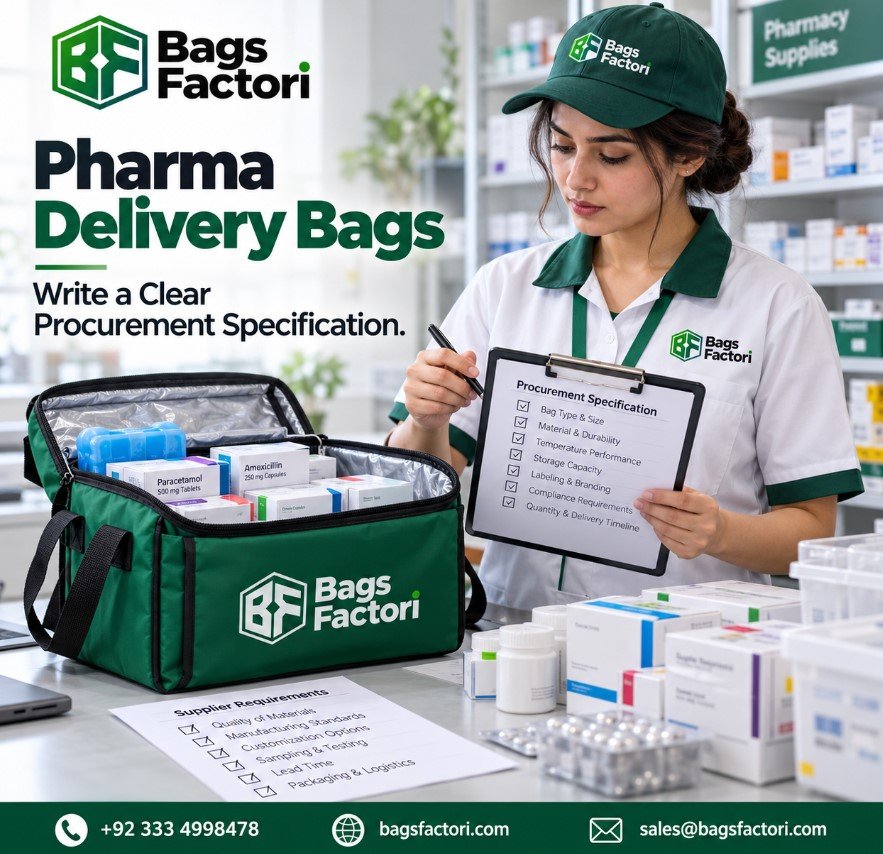
Specify pharma delivery bags with a written brief that identifies the packaged payload, internal clearance, materials, access, cleaning and any required temperature-control system. A general request for a medical-grade bag leaves too many important details undefined. Pakistan pharmacy networks should involve procurement, operations and responsible quality personnel before requesting samples. The result should be a carrier specification suppliers can quote consistently and staff can inspect without relying on broad marketing descriptions.
Define the Intended Use in the First Paragraph
Describe who carries the bag, what approved packaged goods enter it and how the route operates. Include delivery, collection and receiving stages. Distinguish ordinary pharmacy orders from packaged diagnostic samples or other healthcare supplies. Similar product listings can serve different workflows, so clarify the application explicitly.
Record who sets payload handling and packaging requirements. Those requirements should be established before the manufacturer develops the carrier. A supplier can configure dimensions and components but its product name does not determine all shipment obligations. Keep clinical and transport decisions with the responsible personnel.
The pharma delivery bags for pharmacy, clinic and lab configurations page describes different carrier formats and customizable organization. Confirm which model the supplier proposes. The broad page title should not replace the exact configuration identified in your inquiry.
Separate Required Features from Preferences
A required usable dimension or liner compatibility criterion should be clearly distinguished from a preferred color. Identify which features need evidence, which need sample confirmation and which are cosmetic. This helps suppliers suggest workable alternatives without changing essential requirements. It also gives procurement a fair basis for evaluating offers.
Write Dimensions as Usable Space and Opening Clearance
Measure the complete approved packaged arrangement, including any required coolant, protective components and paperwork sections. State internal dimensions after insulation and inserts. Define relevant tolerances with the manufacturer instead of inventing them. A carrier can match the external size while providing too little usable space.
Specify the loading arrangement and permitted payload range. Include the largest recurring package and explain how exceptions are handled. Ask for a layout drawing that shows dividers and sleeves. The sample should confirm that loading and closing do not require changing the approved packaged payload.
Review medical transport planning for pharma, labs and clinics and the pharmaceutical and medical bag category by carrier format. These destinations help compare options, but your written brief remains the basis for model selection and approval.
Name Components and the Evidence Required
Specify the proposed shell, liner, reinforcement, closures, inserts and carrying system. Ask suppliers to identify materials rather than relying on phrases such as durable or premium. If a branded zipper or particular backing is important, record it explicitly. The approval process should identify how substitutions are reviewed.
| Component/material | Buyer benefit | Limitation | Sample or quality check | Specification to confirm |
|---|---|---|---|---|
| Oxford/polyester or nylon shell | Configurable weight and surface | Fabric name is not a bag strength rating | Inspect seams and rubbing points | Fabric construction and backing |
| Documented liner | Supports defined cleaning requirement | No universal disinfectant compatibility | Review procedure and sample | Material identity |
| Specified compartments | Fits approved payloads | Layout changes need review | Trial against drawing | Internal dimensions |
| Optional thermal assembly | Supports specified packout | No standalone temperature guarantee | Review validation scope | Complete system definition |
| Reinforced webbing | Supports intended carrying layout | Anchoring affects stress distribution | Trial approved loaded sample | Webbing and attachment details |
The delivery bag materials and construction information provides a starting point for these discussions. Its published options are not independent proof of chemical resistance, waterproof construction or certified packaging performance. Ask for relevant evidence only where the application requires that claim.
State the intended load and carrying routine. Harnesses, handles and vehicle fittings need practical evaluation at the agreed configuration. Do not infer mechanical lifting suitability or a universal payload rating from a textile grade. The complete assembly is the item being purchased.
Specify Maintenance and Document Handling
Provide the organization’s intended cleaning procedure for review against the actual components. Identify accessible corners, removable inserts and drying requirements. Confirm material compatibility with responsible personnel. A wipe-clean phrase alone leaves uncertainty about chemicals, washing and seam access.
Describe what documents and identifiers the carrier holds. Decide which information should remain protected and which route marking needs visibility. Test sleeve access without disturbing packaged orders. A transparent panel may help recognition while being inappropriate for exposing confidential records.
Compare medical courier carriers emphasizing maintainable access where that is the priority. Backpack configurations can be considered separately through medical bags and medicine courier carrying formats. Keep the selected format’s dimensions and components clear in the final specification.
Document Thermal Requirements as a Complete System
The responsible team should identify any required conditions for the actual products. Record payload, packaging, coolant, preparation, route profile and monitoring where relevant. Carrier insulation is one component of that arrangement. A fixed temperature or duration should not be assumed from foam thickness or foil lining.
The cold-chain carrier page for project-specific packout development can support a specialist discussion. Confirm who provides accessories, evaluation and review. Existing evidence must apply to the proposed build and route, rather than an unspecified similar bag.
Include a change-control requirement for relevant materials and packing arrangements. A substituted liner, different coolant or changed cavity may need review. Preserve the approved sample and applicable records. Procurement should not accept an equivalent-looking replacement without checking the required features.
Set Acceptance and Commercial Terms Together
List what the sample review must confirm: fit, access, component identity, artwork, handling and maintenance. Assign approval responsibilities before bulk manufacture. Record revisions in the specification so verbal changes are not lost. Include the incoming checks needed for the delivered batch.
Current numerical pharma-bag prices were unavailable on the reviewed page. Request an itemized PKR offer for the same approved specification and quantity. Separate sample, setup, packing, tax, freight and any testing services. Confirm MOQ, quote validity and production dates directly.
| Option/specification | Quantity or unit | Price in Rs./PKR | Main cost driver | Source/date |
|---|---|---|---|---|
| Standardized pharmacy carrier | Per bag; state identical-build quantity | Request current quotation | Approved specification | Product page; 4 Oct 2026 |
| Department-specific layout | Per bag; state identical-build quantity | Request current quotation | Pockets and models | Product page; 4 Oct 2026 |
| Thermal configuration | Per bag; state identical-build quantity | Request current quotation | System definition and evidence | Product page; 4 Oct 2026 |
| Sample, setup, packing and delivery | Itemized project quote | Request current quotation | Development and destination | Confirm in written offer |
Use the OEM and ODM bag development and sampling process to discuss implementation. The supplier offer and approved sample should refer to the same version. That connection makes future quotations and inspection more reliable than repeating a broad pharma bag description.
Related Products and Reading:
- Medical courier carriers for maintainable route access
- Medicine courier and medical carrying configurations
- Healthcare carrier planning for pharma, labs and clinics
Frequently Asked Questions About Pharma Bag Specifications:
1. Why is medical-grade an insufficient purchasing description?
It does not define usable dimensions, component identity, handling, maintenance or required evidence. Different suppliers may interpret it differently. Write the actual application and measurable requirements instead. Relevant healthcare and transport obligations should be confirmed by responsible personnel, rather than assumed from a product adjective or category label.
2. Who should contribute to the specification?
Procurement needs commercial details, operations understands loading and handoffs, and responsible quality or healthcare personnel define applicable payload requirements. Involve the intended users in sample review. Assign clear approval roles so a low-price offer or attractive design is not accepted before essential handling and packaging questions are resolved.
3. Should dimensions be stated as outside measurements only?
No. Specify usable internal space and opening clearance around the approved packaged load. Account for lining, thermal components and inserts. External size can be useful for storage or vehicle fit, but it cannot establish payload clearance. Agree tolerances and check the actual arrangement in the sample.
4. What belongs in a bag’s component list?
Identify the shell, backing or coating, liner, panels, reinforcement, handles or harness, closures, inserts and artwork. Specify branded components where required. Record how substitutions are reviewed. A clear component list makes offers more comparable and helps incoming inspection distinguish a similar-looking product from the approved build.
5. How should cleaning requirements be written?
Describe the intended procedure, access needs and drying requirements, then confirm compatibility with the actual materials through responsible personnel. Ask for component information and trial maintenance on the sample. Avoid assuming all disinfectants, immersion or machine washing are permitted because a supplier describes the lining as wipe-clean.
6. Does adding insulation establish medicine transport compliance?
No. Product requirements, packaging, coolant, route, handling and suitable evidence define the complete system. The carrier alone cannot establish a temperature range or compliance. The responsible team should determine the requirements and review the applicable evaluation. Keep any thermal claim connected to the exact proposed configuration.
7. What should sample acceptance criteria include?
Include approved payload fit, opening access, material identities, insert placement, carrying, closure, artwork and maintenance checks. Add application-specific evidence where required. Assign review responsibilities and document changes before approval. The accepted prototype should match the specification and supplier offer that authorize the subsequent bulk production.
8. Can a supplier substitute equivalent materials after approval?
Define the review process before production. Similar names or appearance may conceal changes in cleaning, clearance or handling. Some substitutions may also affect an evaluated thermal system. Require relevant changes to be disclosed and approved by the responsible parties, rather than treating an unspecified equivalent as automatically acceptable.
9. Which commercial details should accompany the technical brief?
State quantity by model, artwork, destination, packing and required schedule. Request MOQ, sample and revision fees, itemized unit price, taxes, delivery, quote validity and payment terms. Confirm what evaluation services are included. These details make offers comparable without inventing standard prices or fixed production promises.
10. How should pharmacy networks manage repeat purchases?
Retain the approved sample, specification version, component list, artwork and relevant operating or evaluation records. Use that reference for quotations and incoming checks. Review changes in payload and route too. Unchanged branding does not prove that a replacement carrier preserves the fit and requirements of the previous program.
Request a Quotation Against a Clear Versioned Brief
Bring together approved payload dimensions, materials, handling, maintenance and evidence needs before requesting prices. Send the specification, quantity, branding and destination through custom pharma carrier design and quotation support. Confirm sample approval responsibilities and commercial terms so the final order is concrete and inspectable.