
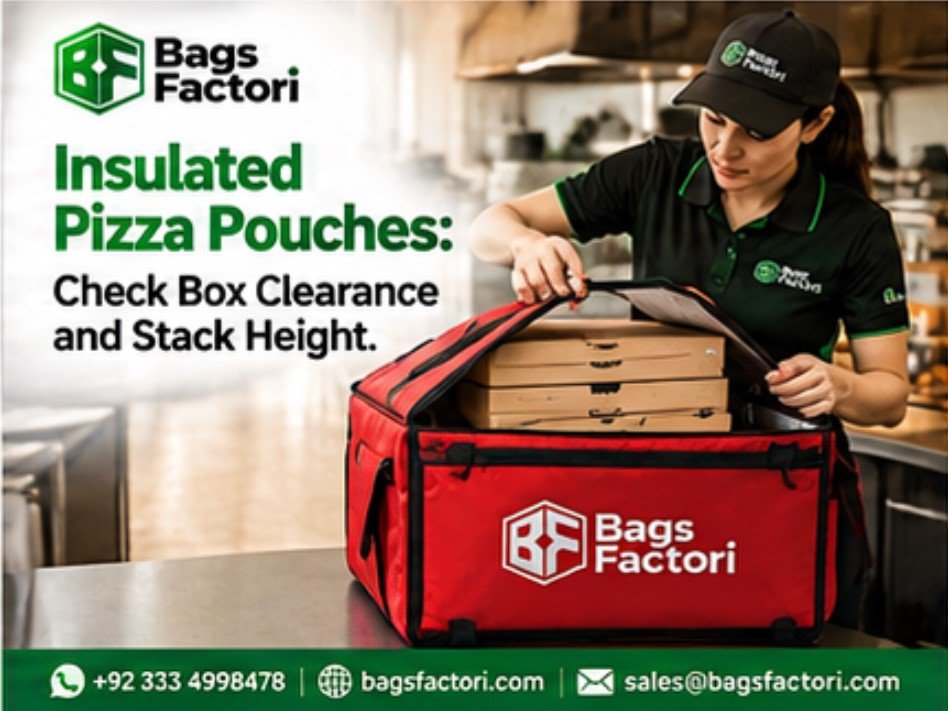
Choose insulated pizza pouches by testing your actual pizza boxes, loading clearance and ordinary stack height. The carrier should support horizontal handling and close without crushing carton corners. For Pakistan pizza restaurants and distributors, a slim-looking pouch is useful only if staff can load it predictably and drivers can retrieve orders without awkward movement. Begin with the complete box arrangement, then compare materials, closure and bulk costs against that specification.
Measure the Pizza Box Rather Than the Pizza Size
The pizza’s advertised diameter does not establish its carton footprint. Measure the closed box, including corner folds and any projecting tabs. Check dimensions across the packaging range used by your kitchen. A supplier change can alter fit even when the menu’s pizza sizes remain the same.
Record stacked height for the number of boxes normally delivered together. Include outer wrapping if it forms part of dispatch. Specify the largest repeatable arrangement rather than an exceptional party order. Separate carrier sizes may be more practical than making every pouch deep enough for the maximum imaginable stack.
The insulated pizza pouches for restaurant bulk orders page describes configurable bases, handles and closures. Confirm the internal footprint and depth for the quoted build. The displayed exterior measurements or photograph cannot prove clearance around your boxes.
Check Entry Clearance as Well as Interior Space
Slide a packed carton through the sample opening without turning it diagonally or pushing down on the lid. Observe contact at zipper corners and flap edges. An interior can be wide enough while the entrance remains awkward. Record both usable cavity measurements and opening geometry in the approval notes.
Choose Stack Height Around Common Orders
A shallow pouch may suit frequent smaller orders, while a deeper pouch supports a different box count. Extra depth also changes carrying and storage. Check the partly loaded arrangement, not just a full stack. Boxes should remain organized without staff improvising packing material to fill gaps.
If removable spacers or dividers are proposed, confirm their purpose and cleaning access. They take up room and may complicate a simple pouch. Avoid adding components that do not solve a recurring operational problem. A defined size range can make dispatch easier than one flexible carrier with unclear limits.
Compare the insulated food carrier category with pizza and meal formats and thermal pizza carriers for alternative loading structures. Keep this pouch selection focused on box clearance rather than treating all pizza carriers as identical.
Inspect the Horizontal Platform and Carrying Points
The base should suit the carton footprint and agreed load. Ask whether reinforcement is removable and whether the bag can fold for storage. Trial normal lifting and setting down. Check whether handles pull the carrier into an awkward shape or allow the platform to sag around box edges.
| Component/material | Buyer benefit | Limitation | Sample or quality check | Specification to confirm |
|---|---|---|---|---|
| Oxford/polyester or nylon shell | Configurable weight and surface | Fabric name is not a bag strength rating | Inspect seams and rubbing points | Fabric construction and backing |
| PE/EPE foam assembly | Slows heat exchange | Needs complete packout testing | Inspect continuity and trial load | Layer arrangement and thickness |
| Reflective/wipe-clean lining | Supports interior maintenance | Corners can trap residue | Reach seams and folds | Liner and compatible cleaners |
| PP-board base or dividers | Supports load organization | Adds weight and reduces usable space | Check deflection and clearance | Placement and removability |
| Reinforced webbing | Supports intended carrying layout | Anchoring affects stress distribution | Trial approved loaded sample | Webbing and attachment details |
The materials and base reinforcement guide for delivery bags helps identify construction questions. BagsFactori lists Oxford shell options, thermal foam and reflective lining for pouches. These options do not establish a universal load rating or retention time.
Inspect stitching at handle anchors, opening ends and bound edges. Evaluate the sample with packed boxes rather than an empty display carton. Confirm the intended carrying arrangement and any shoulder strap separately. A strap’s inclusion does not automatically make a deep stack comfortable or level.
Match Closure Access with the Counter Routine
A flap can offer a broad entrance, while a zipper creates a defined fastening path. Check how kitchen staff keep the entrance clear during loading. Confirm that fastening does not require squeezing the stack. The closure should still align when the pouch contains fewer boxes than its maximum arrangement.
Trial access at customer handover and after repeated use. Check for trapped lining, crumbs around fasteners and areas that collect grease residue. Ask for cleaning instructions compatible with the materials. If branded hardware is important, name it in the quotation and approved component list.
For multi-branch operations, the restaurant and food-chain delivery bag program page offers a framework for standardizing models. Record which pouch fits each carton range. A clear allocation rule helps staff choose the appropriate carrier without guessing.
Evaluate Warmth and Presentation with Actual Packed Orders
Passive insulation may slow heat loss, but outcomes depend on pizza, cartons, waiting time, exposure and opening. Evaluate the complete order on representative delivery journeys under the restaurant’s procedures. Check presentation alongside temperature requirements set by the responsible team. Do not infer fixed performance from a reflective surface alone.
Condensation and packaging behavior also deserve attention in the trial. Discuss changes to ventilation or packing with the team responsible for food handling before modifying the closure. The bag supports the delivery process; it does not replace that process or guarantee food safety. Keep trial observations connected to the tested construction.
Request Like-for-Like Pizza Pouch Quotations
Current numeric pizza-pouch prices were unavailable on the reviewed page. Request PKR offers with the same box footprint, stack clearance, base, thermal assembly, closure and quantity. State the artwork and delivery destination. Ask separately about samples, printing setup, tax and cartons.
| Option/specification | Quantity or unit | Price in Rs./PKR | Main cost driver | Source/date |
|---|---|---|---|---|
| Single-stack pouch | Per bag; state identical-build quantity | Request current quotation | Box footprint | Product page; 4 Oct 2026 |
| Deeper pizza pouch | Per bag; state identical-build quantity | Request current quotation | Stack height and base | Product page; 4 Oct 2026 |
| Branded restaurant pouch | Per bag; state identical-build quantity | Request current quotation | Print and shell | Product page; 4 Oct 2026 |
| Sample, setup, packing and delivery | Itemized project quote | Request current quotation | Development and destination | Confirm in written offer |
The custom bag manufacturing stages from sample to dispatch can help plan approval and inspection. Retain the approved pouch and carton reference. Confirm whether packed freight volume changes with removable panels and whether multiple sizes require separate minimum quantities.
Related Products and Reading:
- Thermal pizza carriers with configurable structure
- Restaurant bag programs for standardized branch supply
- Material and base construction choices for delivery bags
Frequently Asked Questions About Insulated Pizza Pouches:
1. Can I choose a pouch from the pizza’s menu size?
Use the closed box dimensions instead. Menu size describes the pizza and may not match the carton footprint, tabs or corner folds. Measure all packaging variants and the actual stack height. Give the supplier those measurements, then verify loading and closing with the boxes used by your kitchen.
2. How much internal clearance does a pizza pouch need?
It needs enough room to load and retrieve boxes without catching corners or pressing on lids, but excessive empty space may allow movement. Determine the useful allowance with a sample. Account for insulation and base panels. There is no universal clearance figure appropriate for every carton and opening.
3. Why should opening dimensions be recorded separately?
The entrance can be narrower or more restrictive than the interior cavity. Zipper corners, flap overlaps and bound edges may catch boxes during loading. Trial insertion without tilting or forcing cartons. Record the approved opening geometry alongside usable dimensions so repeat production preserves the practical loading arrangement.
4. Is one deep pouch suitable for every box count?
Not necessarily. A deeper pouch can change carrying, storage and partially loaded behavior. Evaluate ordinary orders and the permitted maximum stack. A small range may suit the kitchen better. Define the allowed combinations so dispatch staff do not improvise arrangements that differ from the approved sample trial.
5. Should the base include a rigid panel?
A panel may help support horizontal boxes, but it adds weight and can affect folding and cleaning. Check the loaded platform rather than appearance alone. Confirm panel dimensions, placement and removability. The useful construction is the one that supports your carton arrangement under the agreed carrying routine.
6. Which is easier for a busy kitchen: zipper or flap?
Test the actual counter routine with loaded samples. A broad flap and a zipper offer different access and fastening patterns. Check whether staff can keep the entrance clear, close it without compressing boxes and reopen it at handover. Component quality and geometry matter alongside the fastening type.
7. Do pizza pouches guarantee a fixed hot-delivery duration?
No. Insulation is part of a system involving food, cartons, waiting time, route and opening. Evaluate representative packed orders under your restaurant’s requirements. Avoid adopting a universal retention promise from the material description. A foil lining alone cannot establish arrival temperature or replace food-handling procedures.
8. What should be inspected after routine cleaning?
Check seams, edges, fasteners and any removable base for residue, retained moisture or material changes. Use the approved cleaning method and drying instructions. Do not assume immersion or machine washing suits the construction. Confirm that panels are correctly refitted and closure alignment is maintained afterward.
9. What makes two bulk pouch prices difficult to compare?
Different footprints, stack heights, base reinforcement, thermal layers, closures and branding can describe quite different products. Setup, sample and delivery charges may also differ. Request itemized offers using one approved specification. Compare the delivered project cost rather than treating a generic pizza-pouch unit price as equivalent.
10. What details should a pizza restaurant send for a quote?
Send closed-box measurements, ordinary and maximum stack height, intended load, carrying style and route conditions. Include quantity, logo, colors and destination. Request internal and opening dimensions, sample terms and an itemized PKR offer. Confirm production dates and minimum quantities for each proposed size before ordering.
Approve the Fit Before Branding a Large Order
Test box entry, base support, closure and handover with kitchen and delivery staff. Send your carton measurements, stack arrangements, quantity, branding and destination through custom pizza pouch design and quotation support. Keep the approved construction and packaging reference together for future replenishment.