
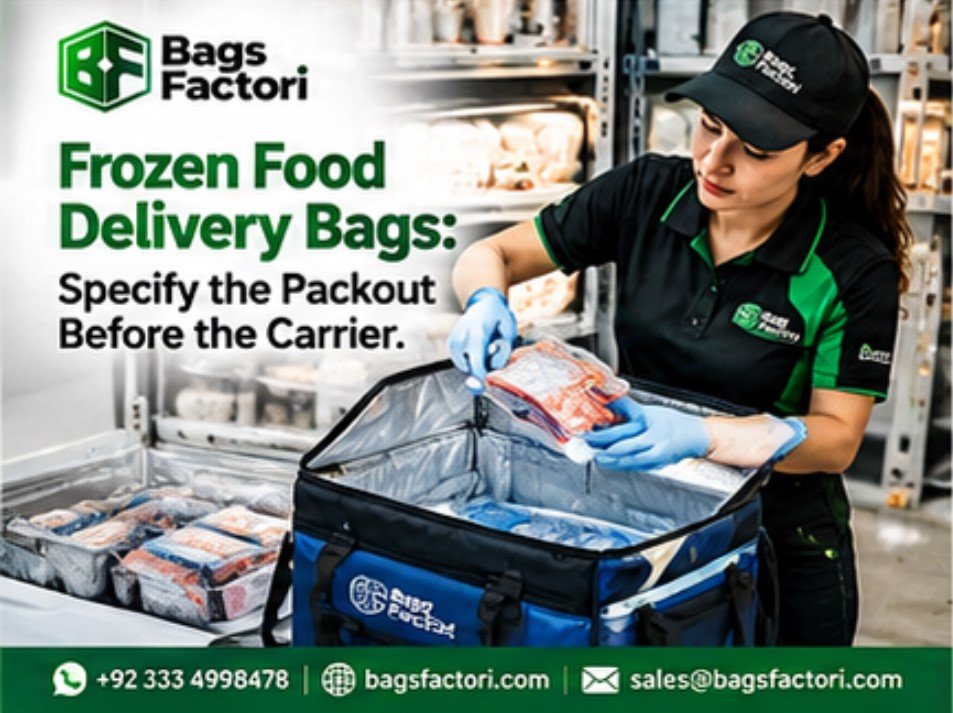
Choose frozen food delivery bags around the packaged product, specified coolant arrangement and delivery conditions together. The outer bag is only one part of that system. Pakistan frozen-food and grocery buyers should confirm usable space, dense-load support and a repeatable packing procedure before comparing bulk prices. Thermal suitability needs appropriate evidence for the complete configuration; a foil lining or thick wall alone cannot establish how long products remain within their required conditions.
Describe the Frozen Order as Packed for Dispatch
Record the product packaging, order quantities and handling requirements set by the responsible team. Identify the smallest ordinary order and the largest permitted load. Include protective cartons and any approved coolant components. Their combined arrangement determines the carrier’s usable space.
Measure external package footprints rather than relying on product weights or bag capacity alone. Dense cartons can fit a cavity while making the resulting load difficult to handle. Confirm the proposed gross load with the supplier and your operation. Separate bag space from the load the staff are expected to manage.
The frozen food delivery carriers with configurable thermal layouts page describes shell, foam, support and coolant-pocket options. Confirm their actual construction in the offer. Published options are not proof of a tested temperature range for your goods.
Keep Frozen and Ambient Items Distinct
A mixed grocery order may contain products with different handling requirements. Define how dispatch separates them before specifying a shared carrier. A divider does not create an independently qualified thermal zone. Your packing procedure should identify the intended contents of each carrier and any restrictions on combining them.
Build a Repeatable Coolant and Payload Layout
Give the supplier the approved coolant-pack dimensions and placement requirements. Specify how the payload is separated or protected where required by the packaging design. Do not select pocket locations solely because they are convenient to sew. They need to work with the complete packout.
A loading drawing should show component positions and the permitted payload range. Record preparation and handling instructions through the responsible team. If operators regularly change the arrangement to make boxes fit, the design and procedure may not align. Revise the prototype before approving a large quantity.
The cold-chain bag category for thermal carrier configurations and cold chain bags for complete system trials offer related starting points. Similar-looking bags should still be evaluated for their specific payload and route.
Check Construction for Dense Frozen Loads
The sample’s handles, base and seams need evaluation at the agreed load. Inspect how webbing is anchored and whether the base distorts around carton edges. Wider handles may change carrying feel but do not establish a payload rating. The supplier should confirm the proposed reinforcement and evaluation basis.
| Component/material | Buyer benefit | Limitation | Sample or quality check | Specification to confirm |
|---|---|---|---|---|
| Oxford/polyester or nylon shell | Configurable weight and surface | Fabric name is not a bag strength rating | Inspect seams and rubbing points | Fabric construction and backing |
| PE/EPE foam assembly | Slows heat exchange | Needs complete packout testing | Inspect continuity and trial load | Layer arrangement and thickness |
| Reflective/wipe-clean lining | Supports interior maintenance | Corners can trap residue | Reach seams and folds | Liner and compatible cleaners |
| Reinforced webbing | Supports intended carrying layout | Anchoring affects stress distribution | Trial approved loaded sample | Webbing and attachment details |
| Coolant sleeves/dividers | Organizes frozen packout | Can crowd dense cartons | Trial smallest and largest load | Packout drawing |
Review materials and reinforced construction for insulated carriers while comparing builds. BagsFactori lists Oxford or coated shell options, thermal foam and reflective lining. Actual thickness, backing and seam details belong in the approved specification.
Check closure alignment after inserting payload and coolant. An overfilled carrier can make fastening difficult and leave gaps. Do not rely on pushing down the lid to compensate for insufficient clearance. Fit should be demonstrated with the complete arrangement and representative packages.
Evaluate the Route and Its Normal Delays
Define the planned duration, waiting time, vehicle exposure and access frequency. Include relevant challenging conditions determined by your quality or operations team. A trial on the shortest journey does not demonstrate every delivery scenario. Record actual conditions so the result can be interpreted properly.
Consider the smallest and largest operating packouts where both are permitted. Changes in load and empty space can affect performance. Appropriate monitoring and acceptance criteria should be selected by responsible specialists. Do not use surface appearance or a hand-touch impression as evidence of thermal compliance.
If the bag also serves foodservice customers, review HORECA delivery carrier planning for different menu loads. Keep the frozen configuration separate from a hot-food transport promise. A reusable carrier should be specified for its intended application rather than advertised as universal.
Plan Cleaning, Drying and Replenishment
Condensation and packaging residue should be considered during maintenance trials. Confirm how staff access liner folds, coolant sleeves and removable inserts. Obtain compatible cleaning and drying instructions for the assembled construction. Inspect the sample after maintenance before accepting repeated-use claims.
Record liner damage, closure faults and reinforcement wear in the deployment process. Decide who checks the carrier before repacking and how unsuitable units are removed from service. A spare-carrier plan may be useful where maintenance and drying interrupt the route schedule. Base replacement forecasts on operational records rather than an invented lifespan.
The manufacturing and sample approval stages for custom bags help structure repeat procurement. Retain the approved build and packout references. Review changes to materials, coolant or product arrangement before treating them as equivalent.
Ask for a Complete PKR Project Quotation
Current numeric frozen-bag prices were unavailable on the reviewed page. Request itemized offers for carrier, sample, printing setup, cartons and delivery. Identify who supplies coolant and monitoring equipment and who arranges any necessary testing. These costs may sit outside the bag manufacturer’s quotation.
| Option/specification | Quantity or unit | Price in Rs./PKR | Main cost driver | Source/date |
|---|---|---|---|---|
| Compact frozen-order carrier | Per bag; state identical-build quantity | Request current quotation | Packout dimensions | Product page; 4 Oct 2026 |
| Dense-carton carrier | Per bag; state identical-build quantity | Request current quotation | Load reinforcement | Product page; 4 Oct 2026 |
| Coolant-pocket version | Per bag; state identical-build quantity | Request current quotation | Insulation and layout | Product page; 4 Oct 2026 |
| Sample, setup, packing and delivery | Itemized project quote | Request current quotation | Development and destination | Confirm in written offer |
Compare identical load clearance, thermal construction and reinforcement at the same quantity. Ask whether tax and freight are included. Confirm project MOQ and dates after sample and material review. A low unit price is difficult to assess if the proposed build does not match the packout being evaluated.
Related Products and Reading:
- Cold-chain carriers for specified thermal packouts
- Foodservice transport planning by menu and load
- Construction and insulation options for delivery bags
Frequently Asked Questions About Frozen Food Delivery Bags:
1. Why specify the packout before choosing the bag?
The bag must fit packaged products, required protective components and the specified coolant arrangement. Selecting a shell first can leave insufficient clearance or force inconsistent loading. Define the complete arrangement and operating conditions, then develop the carrier around them. Thermal suitability needs evidence for that actual system.
2. Can insulation keep frozen goods suitable indefinitely?
No. Passive insulation slows heat exchange; it does not provide unlimited temperature control. Product condition, coolant, route, access and exposure all matter. The responsible team should define requirements and review appropriate testing. Avoid purchasing on an unsupported promise that a bag alone guarantees frozen delivery for a fixed duration.
3. Should coolant pockets be placed wherever there is spare space?
No. Their positions should follow the specified thermal arrangement and practical loading needs. Provide approved pack dimensions and placement instructions. Confirm that pockets do not obstruct the payload or closure. Changes to coolant identity, preparation or positioning need review before they are assumed equivalent to the evaluated packout.
4. Why check the smallest permitted frozen-food order?
A smaller payload can leave a different cavity and packing arrangement from the full load. If that configuration is routinely used, its suitability should be considered in the evaluation. Define permitted loading patterns and coolant requirements. Evidence for a full carrier should not automatically be extended to every lighter order.
5. What matters most for dense cartons of frozen goods?
Check the agreed gross load, base support, handle anchoring and seam construction. Evaluate the sample with representative packaged cartons and the intended carrying method. Interior volume does not establish load capacity. Confirm the supplier’s design limits and avoid choosing a larger cavity that encourages inappropriate loading.
6. Can frozen and ambient groceries share one carrier?
Determine that through the products’ handling requirements and the approved packing process. A divider is not proof of thermal isolation. Separate carriers may be appropriate. Define contents and permitted combinations before developing the bag, then evaluate the complete arrangement rather than assuming mixed orders behave like a frozen-only load.
7. Is a coated shell enough to claim waterproof protection?
No. The seams, openings and pockets also influence water ingress. State exposure requirements and ask for appropriate whole-bag evidence if a waterproof claim is needed. A coated material can support splash resistance, but it should not be used as a universal guarantee for every completed carrier.
8. What should maintenance trials include?
Include access to liner folds, coolant pockets and removable inserts using the agreed cleaning procedure. Confirm compatible products and drying instructions. Inspect retained moisture, material damage and closure operation afterward. Do not assume that machine washing or immersion is suitable simply because the interior is described as wipe-clean.
9. Which costs should be separated in the supplier offer?
Request separate carrier, sample, revision, artwork, cartons, tax and delivery charges. Clarify coolant, monitoring and testing responsibilities. Compare quotes against the same complete specification and quantity. A manufacturing offer may exclude the work and accessories needed to evaluate and operate the intended thermal packaging system.
10. What information should a frozen-food bulk inquiry contain?
Provide product-pack dimensions, permitted payload range, agreed gross load, coolant arrangement, route conditions and required performance criteria. Include quantity, artwork and destination. Request sample terms, an itemized PKR quotation and confirmed production dates. Have the responsible operations or quality team approve the complete arrangement before rollout.
Request a Carrier That Matches the Tested Arrangement
Send your payload, coolant dimensions, loading drawing, quantity, branding and destination through custom frozen-food carrier planning and quotation support. Confirm evaluation responsibilities and sample terms. Preserve the approved construction and packing procedure so repeat orders can be checked against the same requirements.