
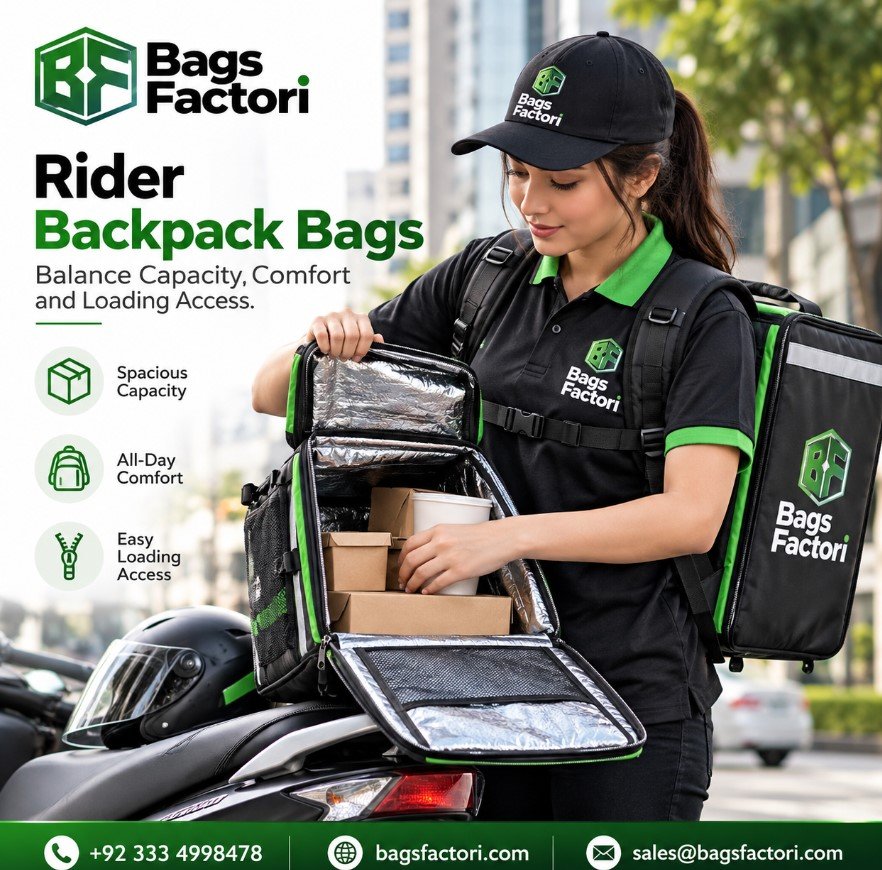
Choose rider backpack bags by testing the intended load on the people who will carry it. Confirm food-box fit, access, harness adjustment and loaded balance before buying a fleet quantity. A large advertised capacity is useful only when staff can load it predictably and riders can manage the resulting carrier. Pakistan food-delivery businesses should evaluate an approved sample across normal pickup and handover tasks, then document the build for repeat purchasing.
Define the Load Instead of Starting with Bag Volume
Measure the complete packed order, including drink holders, outer paper bags and container lids. Use ordinary orders and the largest repeatable combination. Record the arrangement as well as its dimensions. Two meals with equal volume can require different footprints and loading access.
Ask for usable dimensions after insulation, base panels and dividers. External measurements cannot show how much space remains inside. Check the opening against the widest package. Staff should be able to load food without tilting sealed containers or pressing cartons against the zipper.
Review rider backpack bags for customizable food-delivery fleets. BagsFactori describes configurable straps, structure, insulation and compartments. Confirm which options are included in the proposed sample rather than assuming the displayed model represents every quotation.
Set a Clear Capacity Boundary
Specify the intended gross load with the carrier’s own weight accounted for. Agree which order arrangements are permitted and how unusually large orders will be handled. A deeper box may increase apparent space while changing how the load sits behind the rider. Capacity and suitable carrying fit need separate evaluation.
Assess Harness Fit with Representative Riders
Ask more than one intended user to try the loaded sample where practical. Check the available strap adjustment and whether padding sits in useful locations. Observe pickup, removal and short carrying tasks rather than judging only a still photograph. Record where straps press, slide or become difficult to adjust.
A structured back panel may support the carrier’s shape, but its geometry should suit the actual load and user. Avoid assuming extra padding fixes a badly placed load. Keep bulky compartments and hard inserts from creating awkward contact. Discuss changes with the supplier before signing off the sample.
The cloud-kitchen and delivery-app bag planning page connects carrier choices with fleet workflows. Different merchant menus may require different layouts. Standardization is useful when it preserves practical carrying and loading, rather than simply making every backpack look identical.
Choose Structure That Supports Food Packaging
A reinforced base can help cartons remain organized, while dividers can separate packed orders. Both consume space and add weight. Identify which components are necessary for your menu. A fully rigid build is not automatically the best choice for every rider fleet.
| Component/material | Buyer benefit | Limitation | Sample or quality check | Specification to confirm |
|---|---|---|---|---|
| Oxford/polyester or nylon shell | Configurable weight and surface | Fabric name is not a bag strength rating | Inspect seams and rubbing points | Fabric construction and backing |
| PE/EPE foam assembly | Slows heat exchange | Needs complete packout testing | Inspect continuity and trial load | Layer arrangement and thickness |
| PP-board base or dividers | Supports load organization | Adds weight and reduces usable space | Check deflection and clearance | Placement and removability |
| Padded harness and back panel | Supports loaded fit | One geometry may not suit all riders | Trial pickup and carrying | Strap adjustment and padding |
| Reinforced webbing | Supports intended carrying layout | Anchoring affects stress distribution | Trial approved loaded sample | Webbing and attachment details |
The materials and structure guide for delivery backpacks helps frame questions about shell, foam and panels. The published rider page lists possible material combinations. No universal comfortable load, waterproof rating or thermal duration is established by those names.
Trial the carrier when full and after several orders have been removed. Check whether the base remains supported and smaller cartons slide into gaps. Staff should understand how removable partitions are refitted. A layout that depends on guesswork at dispatch is difficult to reproduce across branches.
Keep Access Practical at Pickup and Handover
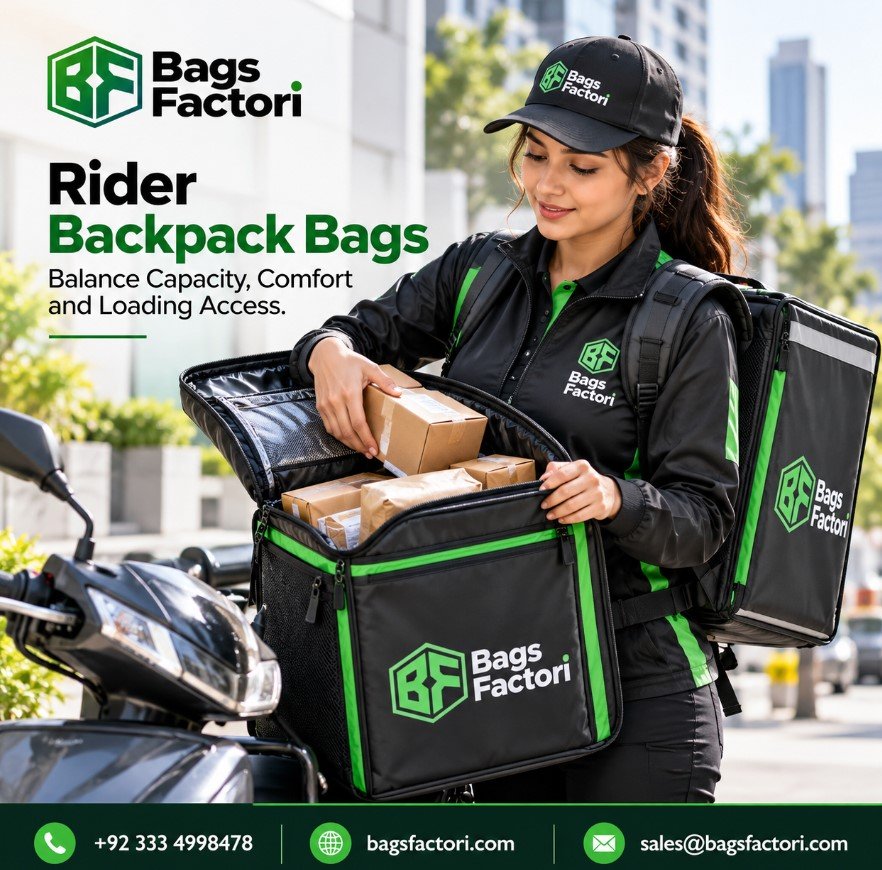
Check whether the opening remains clear on the dispatch counter and whether the lid can be held without obstructing loading. Decide how the rider will retrieve the next order. Top access and front access can suit different layouts; test them with the real packing sequence. Avoid making the rider remove every carton to reach one package.
For burger-heavy menus, compare burger carriers developed around combo-meal packaging. For wide horizontal cartons, the insulated food delivery carrier category offers other formats. One backpack does not need to solve every restaurant’s largest order.
Vehicle mounting should be evaluated separately against the actual rack, attachments and loaded configuration. Backpack straps are not automatically mounting straps. Confirm any specified fittings and keep them clear of moving parts. Do not infer compatibility from a generic motorcycle image.
Evaluate Thermal Layers, Cleaning and Identification
Insulation can slow heat exchange, but food condition depends on packaging, dispatch delays and route handling. Test the actual menu under your operation’s procedures. Drinks need suitable support and primary packaging. A divider alone does not establish separate temperature zones or make cups spillproof.
Inspect how crumbs and sauce residue are reached around seams and panels. Confirm cleaner compatibility and drying instructions for the actual construction. Check logo placement alongside reflective details without treating reflectors as a substitute for required rider equipment. An asset label can help allocate and retrieve bags when your records support it.
Request Prices for the Approved Loaded Design
No numeric rider-backpack prices were available on the reviewed page. Request PKR quotations for the same dimensions, harness, panels, insulation and branding. Ask whether samples, setup, cartons, taxes and delivery are included. Production dates and MOQ need order-specific confirmation.
| Option/specification | Quantity or unit | Price in Rs./PKR | Main cost driver | Source/date |
|---|---|---|---|---|
| Compact food backpack | Per bag; state identical-build quantity | Request current quotation | Size and harness | Product page; 4 Oct 2026 |
| Structured multi-order backpack | Per bag; state identical-build quantity | Request current quotation | Panels and dividers | Product page; 4 Oct 2026 |
| Branded fleet version | Per bag; state identical-build quantity | Request current quotation | Artwork and colors | Product page; 4 Oct 2026 |
| Sample, setup, packing and delivery | Itemized project quote | Request current quotation | Development and destination | Confirm in written offer |
The OEM and ODM development process for fleet bags provides a basis for sample revisions and repeat-order control. Retain photographs and written component details with the approved sample. Changing straps, insert thickness or divider spacing can alter fit even if the exterior looks similar.
Related Products and Reading:
- Burger meal carriers for restaurant combo orders
- Bag programs for cloud kitchens and delivery apps
- Material and panel options for delivery backpacks
Frequently Asked Questions About Rider Backpack Bags:
1. How should a food-delivery fleet choose backpack capacity?
Start with complete packed orders and their arrangement, rather than bag volume alone. Measure ordinary and larger repeatable loads, then confirm usable space after insulation and dividers. Trial the loaded sample with intended riders. Decide how exceptions will be handled instead of encouraging every order into one oversized backpack.
2. Does more padding always improve rider comfort?
No. Padding needs to sit appropriately within a harness and back-panel design that suits the rider and load. Check adjustment, contact points and loaded balance during practical carrying. Added cushioning cannot reliably correct unsuitable geometry. Record user feedback before approving the design for a larger fleet order.
3. Should all riders receive one backpack size?
Only if the approved design works with their carrying needs and the fleet’s order mix. Evaluate representative users and normal loads. A small range may be practical where requirements differ. Standardization should control useful specifications without ignoring users who cannot manage the chosen geometry comfortably.
4. Are internal panels necessary for food delivery?
They can support cartons and preserve shape, but they also add weight and consume internal clearance. Test the menu packaging and loading process. Choose panels and dividers by function. A rigid appearance does not prove better delivery outcomes, and removable components should be easy to fit consistently.
5. Can a backpack carry multiple restaurant orders together?
It may, with suitable packaged-order separation and a loading process that prevents confusion. Test access at successive stops and account for different carton shapes. A partition does not guarantee thermal isolation or spill protection. Define which orders can share the carrier under your own food-handling procedures.
6. What should be checked for motorcycle mounting?
Check the actual rack, fittings, strap routing, load distribution and permitted setup. Backpack straps are not automatically suitable vehicle attachments. Ask for the proposed mounting arrangement in the specification and evaluate the loaded fit. Keep straps clear of moving parts and follow the operation’s applicable riding requirements.
7. Does insulation guarantee meals arrive hot?
No. Thermal layers can slow heat exchange, but results depend on meals, packaging, dispatch time, exposure and repeated access. Trial the complete arrangement on representative routes. Avoid using an unsupported fixed retention promise as the purchasing criterion. The carrier also does not replace the restaurant’s food-handling controls.
8. Which cleaning details matter for structured backpacks?
Confirm whether base panels and dividers should be removed, how seams are accessed and which cleaners suit the lining. Evaluate drying after maintenance. Do not assume machine washing is suitable for the full assembly. Record instructions for staff so inserts are correctly refitted before the next dispatch.
9. How can repeat orders preserve the approved fit?
Retain a reference sample and record dimensions, panel thickness, harness geometry, straps, closures and divider positions. Require review of substitutions. Exterior photographs alone may miss changes that affect loaded fit. Inspect incoming batches against the documented build and maintain the same specification version across procurement teams.
10. What should we send for a fleet backpack quotation?
Send packaging dimensions, order arrangements, intended gross load, carrying and access routines, quantity, artwork and destination. Include thermal, cleaning and mounting requirements where relevant. Request sample terms and itemized PKR charges. Confirm minimum quantities and production dates only after agreeing the proposed construction and approval process.
Approve the Backpack with the People Who Use It
A useful fleet backpack balances packaging fit, accessible loading and workable carrying. Share your order measurements, rider needs, quantity, branding and destination through custom rider backpack design and quotation support. Use the loaded trial to refine the build before committing to repeat supply.