
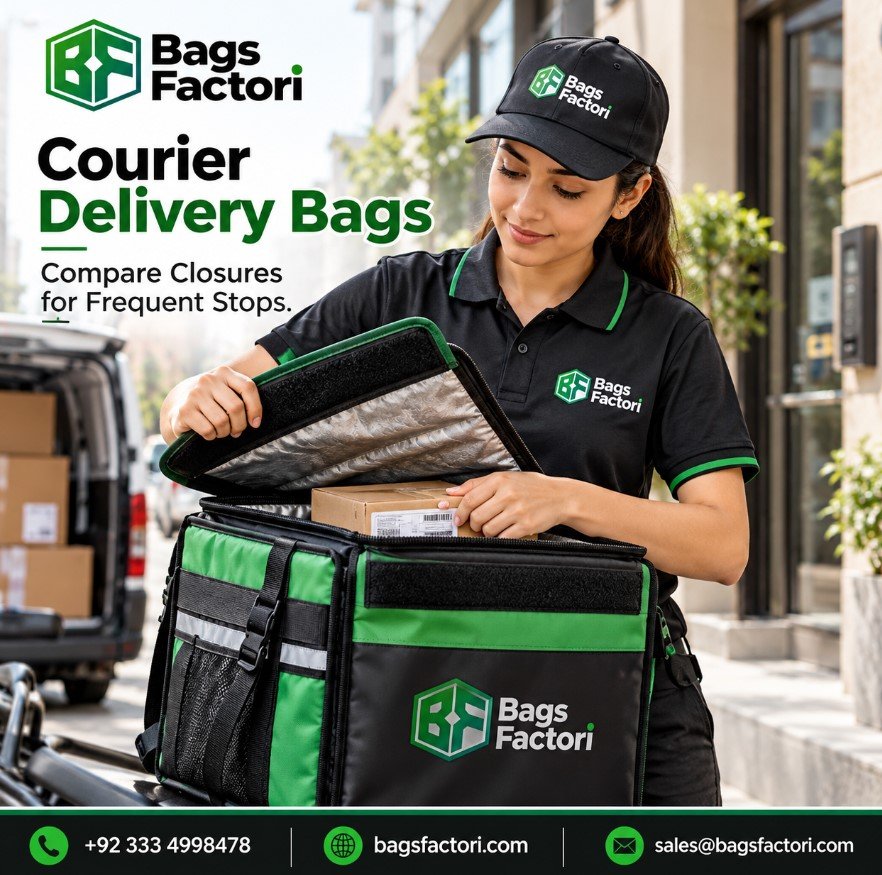
Choose courier delivery bags by testing how staff open, locate, remove and close parcels during a normal delivery stop. A closure that feels strong on an empty sample may snag or become awkward when the bag is full. For Pakistan courier fleets, access and organization deserve a practical trial before bulk buying, alongside fabric, rain exposure and carrying requirements.
Describe the Stop Before Choosing the Opening
Record how the courier approaches a delivery: where the carrier is placed, how the parcel is identified and whether paperwork must be retrieved. Include returns collected during the same route. These actions determine whether top access, a broad flap or another format is useful. Do not choose solely from an exterior photograph.
Measure the largest parcel as well as the typical mix of smaller packages. The opening needs enough usable clearance to remove cartons without catching corners. A deep interior can hide small packets beneath larger boxes. Adjustable organization may help, provided partitions do not make the main package space unusable.
The courier delivery bags for parcel and fleet operations page lists closure, structure and document-window options. Confirm the actual quoted combination. Treat hardware brands and additional flaps as requirements to specify, rather than assumptions about every bag.
Test Access with the Route’s Parcel Mix
Load the sample in the order used at dispatch, then simulate several deliveries and collected returns. Ask the courier to locate a small packet after a large carton has been removed. Note whether the bag collapses, whether dividers move and whether the closure remains aligned. The test should include ordinary handling rather than an arranged showroom demonstration.
Compare Zippers and Flaps Under a Full Load
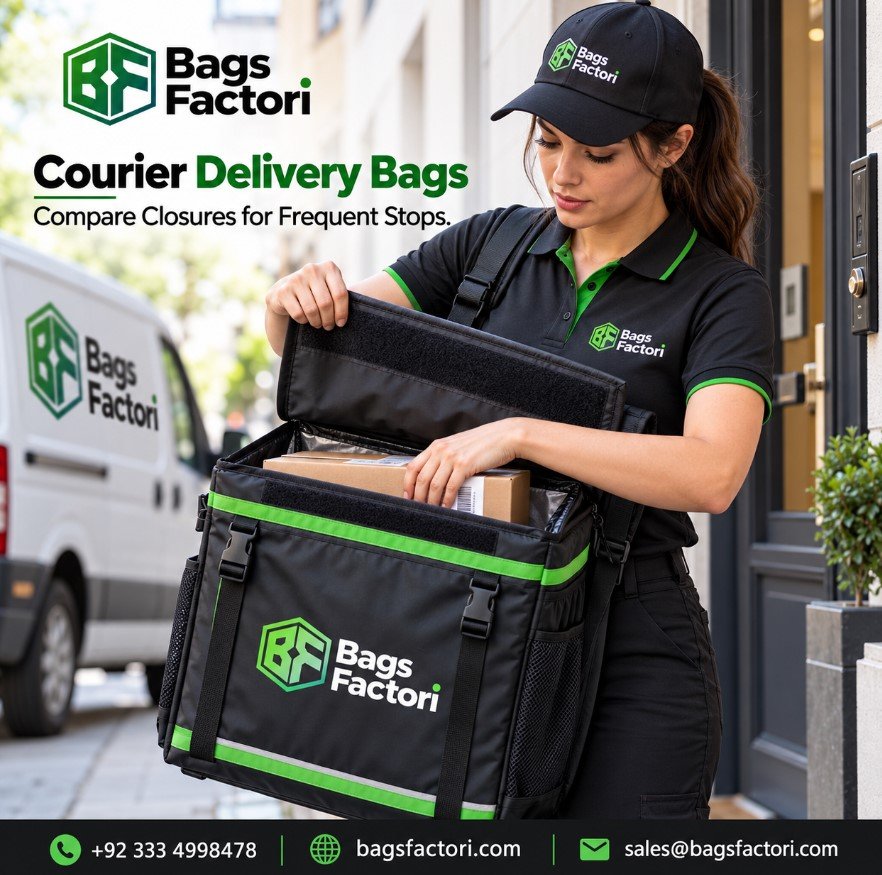
A zipper can provide a defined opening, but its path and corners influence operation. Check whether fabric folds into the slider and whether package pressure pulls the opening out of alignment. Large pulls may improve grip for some routines, but the complete hardware should be trialed. An expensive component does not compensate for unsuitable geometry.
A flap may offer broad access and cover the opening, while its fastening arrangement determines how staff secure it between stops. Confirm whether it remains clear during loading and whether the overlap reaches properly when full. Hook-and-loop areas can collect debris. Evaluate the closure after repeated use and the agreed maintenance procedure.
Compare other formats in the courier and logistics carrier category. Where the route requires backpack carrying, inspect parcel delivery backpacks with configurable internal layouts separately. A hand-carry carrier’s opening cannot be assumed to work equally well on a backpack.
Match the Shell and Structure to Access Requirements
A soft shell can fold around small parcels and store compactly when empty. It may also need support to keep the opening clear as the load decreases. Structured panels can preserve access and package organization, but add weight and reduce flexibility. Specify the minimum structure that makes the workflow practical.
| Component/material | Buyer benefit | Limitation | Sample or quality check | Specification to confirm |
|---|---|---|---|---|
| Oxford/polyester or nylon shell | Configurable weight and surface | Fabric name is not a bag strength rating | Inspect seams and rubbing points | Fabric construction and backing |
| Coated shell or tarpaulin | Addresses splash exposure | Openings can admit water | Inspect assembled closure | Coating, seams and exposure test |
| Reinforced webbing | Supports intended carrying layout | Anchoring affects stress distribution | Trial approved loaded sample | Webbing and attachment details |
| PP-board base or dividers | Supports load organization | Adds weight and reduces usable space | Check deflection and clearance | Placement and removability |
| Zipper or flap | Matches frequent-stop access | Can snag with full load | Repeated loaded closure trial | Opening and hardware |
The materials and quality guide for delivery bag construction helps frame questions about shell, base and closures. BagsFactori lists Oxford fabric, coated options and configurable panels for courier bags. Their presence in the product description does not confirm one payload rating or service life for all designs.
Inspect handle anchoring and the points used when transferring the loaded carrier into a vehicle. Keep loose straps and fittings clear of the closure. Agree the maximum intended load and handling method. The bag’s interior volume should not encourage staff to exceed those arrangements.
Place Labels and Documents Where They Help
A route window may identify the current dispatch group, while an asset number identifies the carrier itself. Keep these functions understandable to staff. Place the window where it can be read without opening the bag. Check whether stacked carriers or folded flaps cover important information.
A separate document pocket can prevent couriers from searching through parcels for routine forms. Decide what belongs outside and what must stay protected inside. Labels and barcodes support your records but do not create tracking automatically. Trial recognition and scanning through the actual handoff process.
For multi-stage networks, review e-commerce and 3PL carrier planning across fulfillment and delivery. Keep hub-transfer identification separate from individual customer information. Avoid exposing unnecessary personal details on visible panels.
Evaluate Weather Exposure at the Opening
A coated exterior may resist splashes while the closure remains vulnerable. State where the carrier will be exposed and whether it is normally inside a vehicle. Ask how seams, flap overlaps and zippers are constructed. Whole-bag waterproof claims need appropriate evidence; a shell description alone is insufficient.
Inspect the sample after the relevant exposure trial and cleaning routine. Look for damp pockets, trapped moisture and difficult drying areas. Ensure the agreed maintenance does not interfere with fasteners or labels. Routine parcels usually need suitable organization and weather protection more than optional thermal layers.
Compare Purchasing Costs Across the Same Access Design
No numeric courier-bag prices were available on the inspected product page. Request a dated PKR quotation against the same usable dimensions, opening, shell, structure and branding. Itemize special hardware and additional pockets. Ask which charges include samples, cartons, taxes and delivery.
| Option/specification | Quantity or unit | Price in Rs./PKR | Main cost driver | Source/date |
|---|---|---|---|---|
| Soft parcel carrier | Per bag; state identical-build quantity | Request current quotation | Shell and opening | Product page; 4 Oct 2026 |
| Structured carrier | Per bag; state identical-build quantity | Request current quotation | Base and closure | Product page; 4 Oct 2026 |
| Frequent-access version | Per bag; state identical-build quantity | Request current quotation | Hardware and flap | Product page; 4 Oct 2026 |
| Sample, setup, packing and delivery | Itemized project quote | Request current quotation | Development and destination | Confirm in written offer |
The OEM and ODM process for custom courier bag development can support sample planning and specification control. Retain an approved reference and record closure components carefully. A substitute zipper, flap overlap or panel layout may change access even if the outside size remains similar.
Related Products and Reading:
- Parcel backpacks for rider-based package deliveries
- Carrier choices for e-commerce and 3PL workflows
- Material and closure questions for delivery bag buyers
Frequently Asked Questions About Courier Bag Access:
1. What is the most useful closure for frequent delivery stops?
The useful choice is the one that works with your parcel mix and handoff routine. Compare loaded zipper and flap samples rather than assuming one is universally quicker. Check opening clearance, snagging, fastening effort and organization after several parcels have been removed and returns added.
2. Should courier bags open at the top or the front?
Choose according to where the carrier sits and how staff retrieve parcels. Top access may suit some vehicle or hand-carry routines, while broad front access changes loading and support needs. Trial the actual position. Ensure packages can be removed without damaging corners or disturbing unrelated orders.
3. Does a named zipper brand guarantee a better bag?
No. Hardware quality matters, but the installation, path, end reinforcement and loaded alignment also affect performance. Specify a required brand or component in writing and inspect the sample. Compare the whole closure arrangement rather than treating a brand name as evidence for complete-carrier durability.
4. Are rigid panels necessary for a courier carrier?
They may help preserve opening shape and organize parcels, but they add weight and reduce folding flexibility. A soft carrier may suit other routes. Test the sample as the load decreases during deliveries. Choose structure according to access and package support rather than exterior appearance alone.
5. How should collected returns be organized?
Define a separate, clearly understood location or carrier for returns so staff do not confuse them with outbound orders. Check whether the chosen partition preserves usable parcel clearance. Simulate collection during sample evaluation. Route records and identification remain necessary; a compartment alone does not control the process.
6. Can a document window serve as parcel tracking?
It can display identification, but tracking requires operational records and a process for capturing handoffs. Confirm window placement, label readability and any scanning needs. Separate temporary route information from permanent carrier identity. Do not assume a printed barcode creates live visibility into parcel movements by itself.
7. Does a coated shell protect parcels in all rain?
Not automatically. Water can enter through seams, pockets and closures. Describe expected exposure and request evidence for any whole-bag protection claim. Inspect the assembled sample. A rain-resistant material is one component choice and should not be presented as a universal guarantee that every parcel stays dry.
8. What should a courier sample trial include?
Use representative parcels, normal dispatch order, several simulated stops and collected returns. Check package removal, closure alignment, carrying points and label access. Observe the carrier when partly empty. Include the agreed cleaning routine so the approved design reflects ordinary use beyond a single full-load demonstration.
9. Why should quotations identify closure hardware separately?
Different sliders, fasteners, flap constructions and reinforced ends can change both cost and operation. A quotation that simply says heavy-duty closure leaves room for misunderstanding. Record the approved components and opening geometry. Compare those details along with dimensions, material, pockets, branding and delivered project cost.
10. What should fleet buyers include in the inquiry?
Send parcel dimensions, typical package mix, access routine, carrying style, agreed load and exposure conditions. Include quantity, artwork, route labels and destination. Request sample terms, component details and an itemized PKR quote. Confirm minimum quantity and production dates after the final access design is approved.
Request a Sample That Represents a Real Route
Start with the delivery stop and work backward to the closure, organization and shell. Share package measurements, route handling, quantity, branding and destination through custom courier carrier design and quotation support. Approve the loaded sample and written component specification before ordering across the fleet.