
Description
Specifications for Insulated Thermal Food Delivery Bags
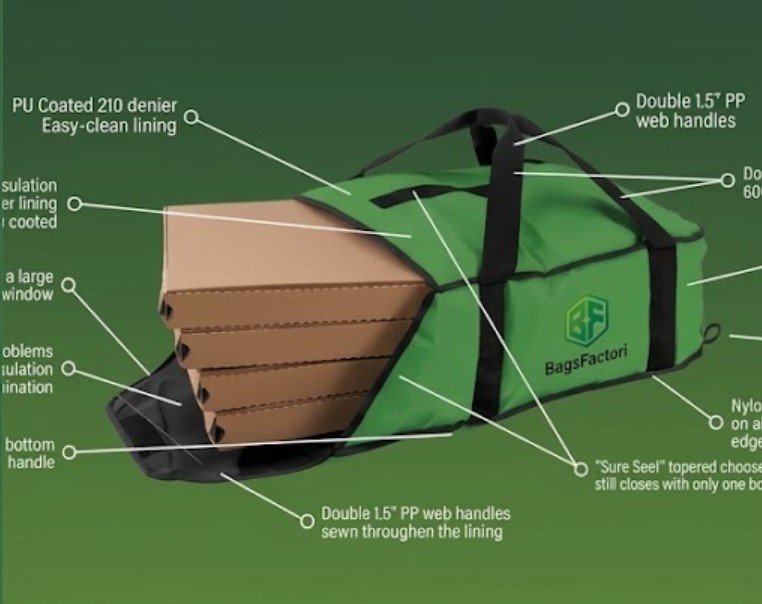
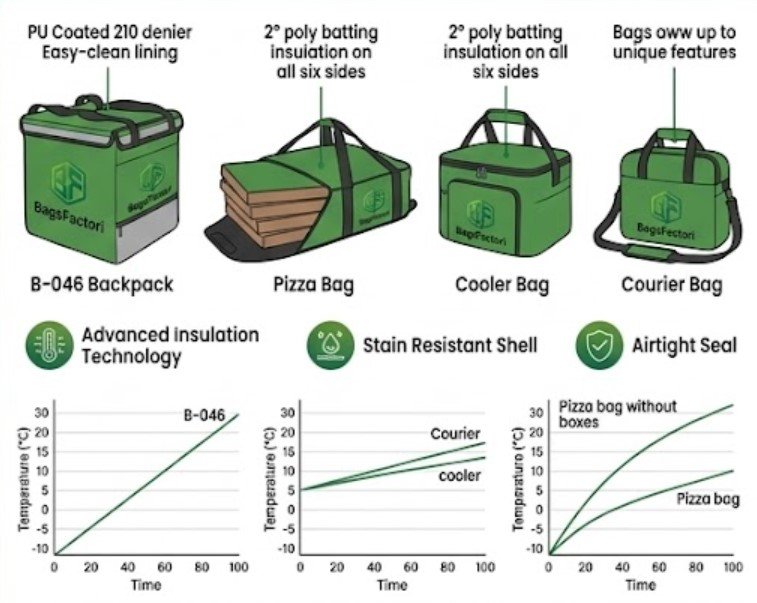
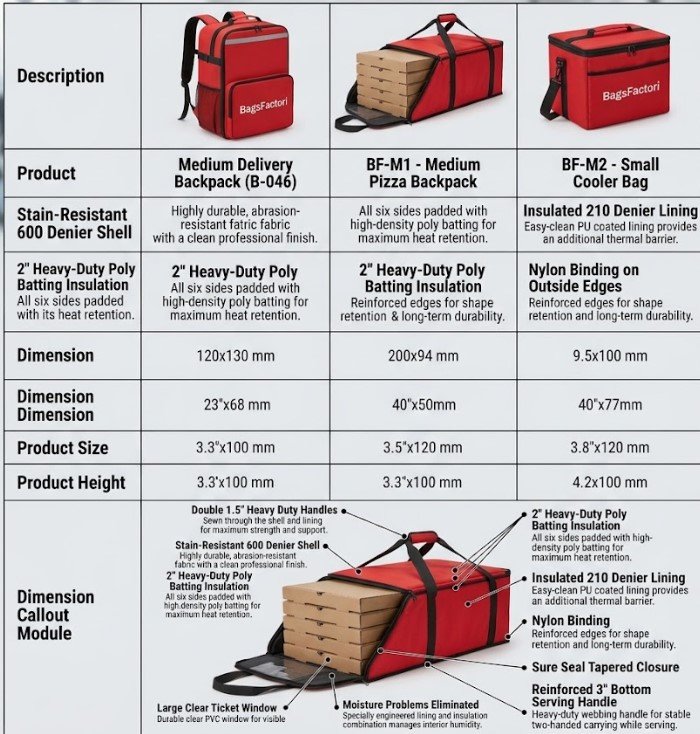
Construction is selected according to payload, delivery time, rider environment and cleaning requirements. A typical commercial insulated bag for food delivery may use 600D or 1680D Oxford fabric, PVC-coated tarpaulin or ripstop-style outer materials. Closed-cell PE or EPE-type foam can be specified for insulation, while aluminum thermal lining or wipe-clean liner options support hot-food transport and routine cleaning.
Structural reinforcement can include PP board panels or an aluminum support frame where a more rigid body is required. Handles and shoulder straps can be reinforced with nylon webbing, while reflective strips can be added for rider visibility. Heavy-duty zippers are standard design options; branded zipper systems such as YKK may be specified where the buyer requires a particular component standard. Materials and constructions should always be confirmed on the approved sample and purchase specification.
Product Specifications & Technical Details
| Feature / Specification | Technical Standard | B2B Advantage |
| Outer Fabric | 600D/1680D Oxford, PVC tarpaulin or specified equivalent | Balances abrasion resistance, branding surface and daily fleet use |
| Insulation | Closed-cell PE/EPE-type foam; thickness customized | Supports hot food delivery bags and temperature retention requirements |
| Inner Lining | Aluminum thermal lining or wipe-clean liner options | Easier cleaning and improved thermal performance |
| Structure | Soft-sided, PP board reinforced or aluminum frame | Matches motorcycle, catering or hand-carry applications |
| Closure | Heavy-duty zipper, flap or Velcro configuration | Faster loading and secure transport |
| Branding | Screen print, embroidery, heat transfer, woven labels | Turns each delivery bag for food into mobile brand visibility |
| Safety | Optional reflective strips | Useful for rider fleets and night operations |
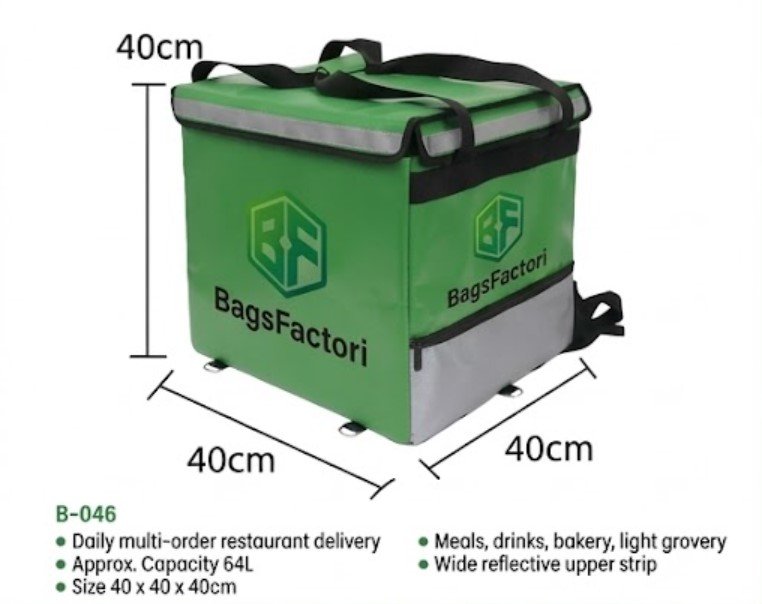
| Size | Standard reference sizes or fully custom dimensions | Fits meal boxes, trays, beverage holders and operational loads |
Bulk Food Delivery Bags, Pricing Tiers and OEM/ODM Customization
BagsFactori handles wholesale and project-based requirements rather than fixed retail configurations. Final pricing depends on dimensions, fabric, foam thickness, frame construction, zipper specification, logo method, print coverage, packaging and order quantity.
B2B Wholesale & Quantity Pricing Structure
| Order Band | Commercial Use | Sample Availability | Production Planning |
| 50–200 units | Trials, restaurant groups, local fleet rollouts | Available subject to specification | Confirmed with approved design and material |
| 201–500 units | Multi-branch chains and regional distributors | Recommended before bulk | Scheduled after sample/PO approval |
| 500+ units | Delivery platforms, importers and large distributors | Pre-production approval recommended | Production plan quoted by quantity and complexity |
| Repeat Programs | Scheduled replenishment and private-label supply | Golden sample/specification retained where agreed | Planned against forecast and reorder requirements |
OEM/ODM options include custom Pantone-style color matching subject to material availability, screen printing, embroidery, heat-transfer graphics, woven labels, rubber or molded patches where technically suitable, reflective safety strips, custom pockets, receipt windows, drink holders, adjustable dividers and buyer-specific carton markings.
For highly specialized logistics or non-food applications, procurement teams can also review Courier & Logistics Bags and PP Woven Logistics Sorting Bags for separate operational requirements.
Types and Design Features of Food Delivery Bags
Insulated Thermal Food Delivery Bags for Hot Meals
These models prioritize thermal retention, clean internal surfaces and easy loading. They can be built as top-opening, front-opening or hand-carry formats depending on the meal boxes being transported.
Food Delivery Backpacks for Rider Fleets
Backpack-style models can include padded shoulder straps, chest support, reflector strips and reinforced bases.
Partitioned Delivery Bags for Food
Internal dividers help separate meals, beverages and different order groups. Removable or adjustable partition systems allow operators to change the internal layout while keeping the external bag standardized across the fleet.
Key Benefits of Commercial Food Delivery Bags
For enterprise buyers, the value of a customized thermal food delivery bag is operational consistency rather than appearance alone.
- Improved product protection: insulated, structured construction helps protect meals during loading, riding and handover.
- Brand visibility: custom logos and brand colors turn each food bag for delivery into a moving customer touchpoint.
- Fleet standardization: agreed dimensions and materials make repeat ordering easier across branches or territories.
- Weather resistance: coated outer fabrics can provide better protection against routine outdoor exposure.
- Operational flexibility: dividers, pockets, reflector strips and carrying systems can be configured by use case.
- Procurement efficiency: sample approval and documented specifications reduce uncertainty before larger bulk orders.
Pros and Cons: Custom OEM Bags vs Generic Food Delivery Bags
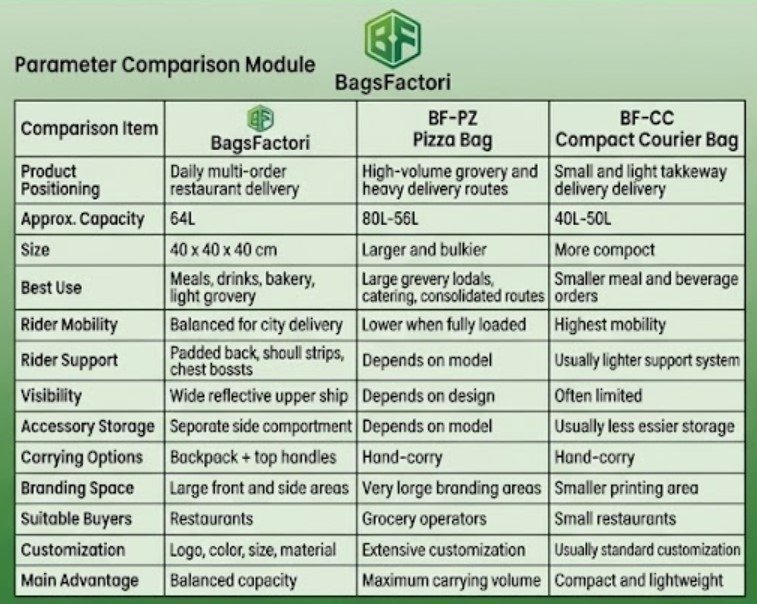
| Factor | BagsFactori OEM/ODM Program | Generic Mass-Market Bag |
| Branding | Buyer-specific logo, colors and labels | Usually limited or absent |
| Dimensions | Customizable around packaging and route | Fixed standard size |
| Insulation | Specified according to application | Unknown or fixed construction |
| Structure | Soft, reinforced or framed options | Limited choice |
| Repeat Supply | Built around an approved specification | Product may change by seller |
| Trade-off | Development/sample stage required | Faster immediate purchase for very small quantities |
Custom manufacturing is best suited to buyers who value repeatability, fleet presentation and fit-for-purpose design.
Global Suitability of Insulated Bags for Food Delivery
Different markets create different operating demands. For Dubai, the UAE and Saudi Arabia, buyers often prioritize stronger insulation, easy-clean liners and durable outer materials because deliveries may face high ambient temperatures. In the UK, Germany, France, Italy, Spain and the Netherlands, weather resistance, reflector visibility and practical cleaning can be important for year-round rider use.
USA, Australia, South Africa and Mexico buyers may require different capacity ranges, carton packing, labeling or distributor-ready specifications. BagsFactori can manufacture to buyer-provided requirements, but regulatory or food-contact compliance should never be assumed from the product name alone. If a project requires a specific material declaration, test report, labeling standard or certification, include that requirement in the RFQ so it can be reviewed before production.
FAQs: About Insulated Thermal Food Delivery Bags
1. What is the MOQ for custom food delivery bags?
MOQ depends on size, materials, branding and construction. For planning, buyers can request quotations for trial quantities and larger 50–200, 201–500 and 500+ unit programs. The final MOQ is confirmed against the exact specification.
2. Do you offer OEM/ODM branding on food bags for delivery?
Yes. Branding options can include screen printing, embroidery, heat transfer, woven labels and selected patch formats, subject to the bag material and artwork.
3. What materials are used for insulated thermal
food delivery bags?
Common options include Oxford fabric or PVC-coated outer materials, closed-cell PE/EPE-type insulation and aluminum thermal or wipe-clean internal lining. Construction is customized by application.
4. Can I request a pre-production sample?
Yes. A physical sample can be produced so your team can review dimensions, materials, stitching, insulation, branding and functionality before approving bulk production.
5. How long does shipping take to the USA, UK, UAE or Europe?
Transit time depends on destination, shipment size and freight method. Samples are commonly shipped by courier, while bulk orders can move by air or sea. Exact shipping and production timelines are provided with the quotation.
6. How do these delivery bags insulated for food handle extreme weather?
Performance depends on insulation thickness, closure design, route duration and ambient conditions. For demanding climates, request a higher insulation specification and weather-resistant outer fabric during product development.
7. Are the bags washable and easy to sanitize?
Many configurations use wipe-clean liners and water-resistant outer materials. Cleaning instructions depend on the selected fabric, printing method, foam and internal lining, so the approved specification should define the recommended cleaning method.
8. What payment terms and trade assurance are available?
Payment structure is agreed according to order value, buyer history and transaction method. New projects normally receive a formal quotation or pro forma invoice before production. Buyers requiring LC or specific banking terms should state this during RFQ review.
9. How are bulk food delivery bags packed for export?
Packing can be planned around bag dimensions and freight efficiency, using export cartons and buyer-specific carton marks where requested. Folding method and carton quantity are confirmed before shipment.
10. Can you manufacture custom dimensions and dividers?
Yes. Buyers can specify external dimensions, internal partitions, removable dividers, pockets, beverage sections, handles, shoulder straps and other functional requirements. Send your box sizes or reference design for development.

Reviews
There are no reviews yet.